AI estimate as of October 31, 2025 · verify with a professional before acting
AI-Generated · Verify before acting
Everything on this page is generated by AI for informational purposes only. AI can make mistakes — the AI may misidentify items or misattribute them (artist, maker, brand, designer, origin, era). This is not an official valuation and should not be used for insurance, sale, tax, estate, legal, or lending purposes — or any decision requiring a certified appraisal. It is not an authoritative claim about any person, brand, or rights holder — do not share or rely on it as a factual statement about a third party. Always consult qualified professionals before making financial decisions.
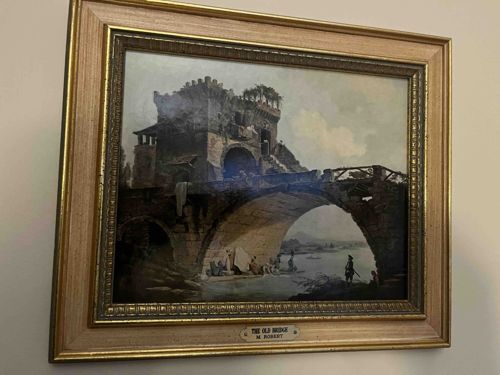
This item is a framed print or reproduction of a painting titled 'The Old Bridge', attributed to M. Robert, likely an abbreviation for Hubert Robert (1733-1808), a renowned French painter known for his picturesque ruins and landscapes. The artwork depicts a classical-style stone bridge with multiple arches spanning a river. On the left side of the bridge, a substantial structure, possibly a fortified tower or derelict building, rises with visible details of crumbling masonry, arched windows, and overgrown vegetation. Figures can be seen gathered by the riverbank under the bridge's arch, suggesting a scene of daily life or leisure. Another lone figure stands on the right bank, observing the scene. The color palette is earthy, dominated by browns, grays, and muted greens, with a pale blue sky suggesting a cloudy or overcast day. The print is housed in a multi-layered frame. The outermost layer is a light-colored, possibly natural wood or faux-wood finish, with a slightly textured or distressed appearance. Inside this, there's a thin gold-colored fillet, followed by a wider inner frame painted with an intricate, possibly carved, ornate pattern, also in gold. The innermost edge features another slender gold-colored border that directly abuts the artwork. A small brass or gold-tone plaque is attached to the bottom center of the frame, bearing the title 'THE OLD BRIDGE' and 'M. ROBERT'. The visible condition suggests some surface reflections on the glass or protective layer, indicating it's possibly a print behind glass. There are no obvious signs of significant damage to the artwork itself, though the frame shows minor wear consistent with age and handling. The overall aesthetic points to an ornate, classical style, possibly from the late 19th or 20th century as a reproduction of an 18th-century work.
AI Appraisal Report
I've examined the provided image of 'The Old Bridge (after Hubert Robert).' This appears to be a framed print or reproduction of a work by M. Robert, likely Hubert Robert. Visually, the print itself seems to be in good condition, with no obvious tears, significant discoloration, or water damage, though reflections on the glazing prevent a definitive statement on surface condition. The frame, while ornate and generally well-preserved, exhibits minor wear consistent with its likely age and handling, including possible minor scuffs or chips not fully discernible from the image. The brass plaque adds a touch of perceived quality but doesn't impact intrinsic value.
Authenticity: Based solely on the image, this is clearly a reproduction of an 18th-century painting, not an original work by Hubert Robert. Its value is therefore as a decorative art print. The market for decorative prints of classical landscape scenes is generally modest. Factors impacting value include the quality of the print (e.g., giclée vs. offset lithograph), its age, and the quality and condition of the framing. While Hubert Robert is a recognized artist, reproductions don't command high prices unless they are rare, early engravings or limited editions signed by the printmaker.
Demand for such decorative pieces is steady but not high-end. Rarity is low given it's a reproduction. For a more definitive appraisal regarding the print method or its specific age, an in-person examination would be critical to inspect the paper, print dots, and framing techniques. Provenance documentation linking it to a specific print run or publisher would also be beneficial for establishing any secondary market value beyond decorative appeal.