AI estimate as of June 18, 2025 · verify with a professional before acting
AI-Generated · Verify before acting
Everything on this page is generated by AI for informational purposes only. AI can make mistakes — the AI may misidentify items or misattribute them (artist, maker, brand, designer, origin, era). This is not an official valuation and should not be used for insurance, sale, tax, estate, legal, or lending purposes — or any decision requiring a certified appraisal. It is not an authoritative claim about any person, brand, or rights holder — do not share or rely on it as a factual statement about a third party. Always consult qualified professionals before making financial decisions.
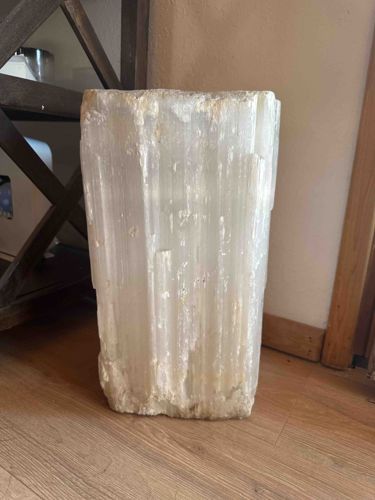
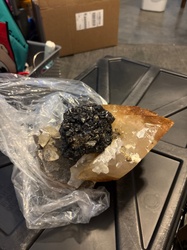
The item is a large, raw specimen of Selenite. It is a substantial chunk of crystallized mineral, exhibiting the characteristic fibrous and striated texture of Selenite. The color is predominantly translucent white to a very pale yellow or beige, with some areas appearing more opaque and milky. The overall form is roughly rectangular, with a flattened base that allows it to stand upright. The top surface is irregular and shows the natural cleavage planes of the mineral. The sides are composed of tightly packed, elongated crystals, giving it a columnar appearance. The base is more rough and appears to be where the specimen was broken from a larger formation, displaying a more earthy and less crystalline texture with some dirt or matrix material still attached. Individual crystal bundles are visible running vertically along the sides. There are no visible signs of significant damage, repairs, or artificial enhancements. The natural raw state of the mineral indicates it is likely a recent find or a relatively modern specimen, focusing on its natural beauty rather than being a historical piece. The luminescence and clarity of Selenite vary depending on its source and grade, and this piece appears to be of good visual quality for a natural specimen. No manufacturing marks or signatures are present, as this is a natural mineral formation.
AI Appraisal Report
Based on my visual examination of the image provided, this appears to be a large, raw specimen of Selenite. The characteristic fibrous and striated texture, translucent white to pale yellow coloration, and natural cleavage planes are consistent with authentic Selenite. The condition appears good for a raw mineral specimen, showing the natural broken base and crystalline growth along the sides. There are no visible signs of damage or repair. The authenticity seems likely based on these features; however, definitive verification of authenticity and origin would require in-person examination, potentially including tests for hardness, cleavage, and density, along with provenance documentation if available. Market conditions for natural mineral specimens like Selenite are generally stable, with value influenced by size, clarity, form, and origin. Comparable large Selenite clusters of this size and visual quality typically fetch prices ranging from moderate to significant depending on the retail channel (e.g., online, specialty mineral shops, or shows). While Selenite itself is not extremely rare, large, aesthetically pleasing, and intact specimens like this command higher prices than smaller or less visually appealing pieces. Factors significantly impacting the value of this specimen include its substantial size, good form, and apparent clarity. Without a physical inspection to confirm weight, exact dimensions, and to rule out any subtle alterations or enhancements not visible in the image, this appraisal is based solely on the visual evidence presented. A physical examination would provide a more precise basis for valuation.