AI Appraisal Estimate

AI-generated estimates · not official valuations

From the user

What was submitted

Photo and notes provided by the user — not generated by AI

Submitted item photo
Submitted photo · July 11, 2026

User's notes

No additional notes provided.

AI analysis below

AI appraisal

AI analysis & estimate

AI-Generated · Verify before acting

Everything below is generated by AI for informational purposes only. AI can make mistakes — the AI may misidentify items or misattribute them (artist, maker, brand, designer, origin, era). This is not an official valuation and should not be used for insurance, sale, tax, estate, legal, or lending purposes — or any decision requiring a certified appraisal. It is not an authoritative claim about any person, brand, or rights holder — do not share or rely on it as a factual statement about a third party. Always consult qualified professionals before making financial decisions.

Read the full disclaimer

AI Identification

·Not independently authenticated·Verify before acting

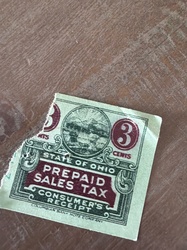
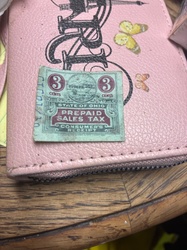
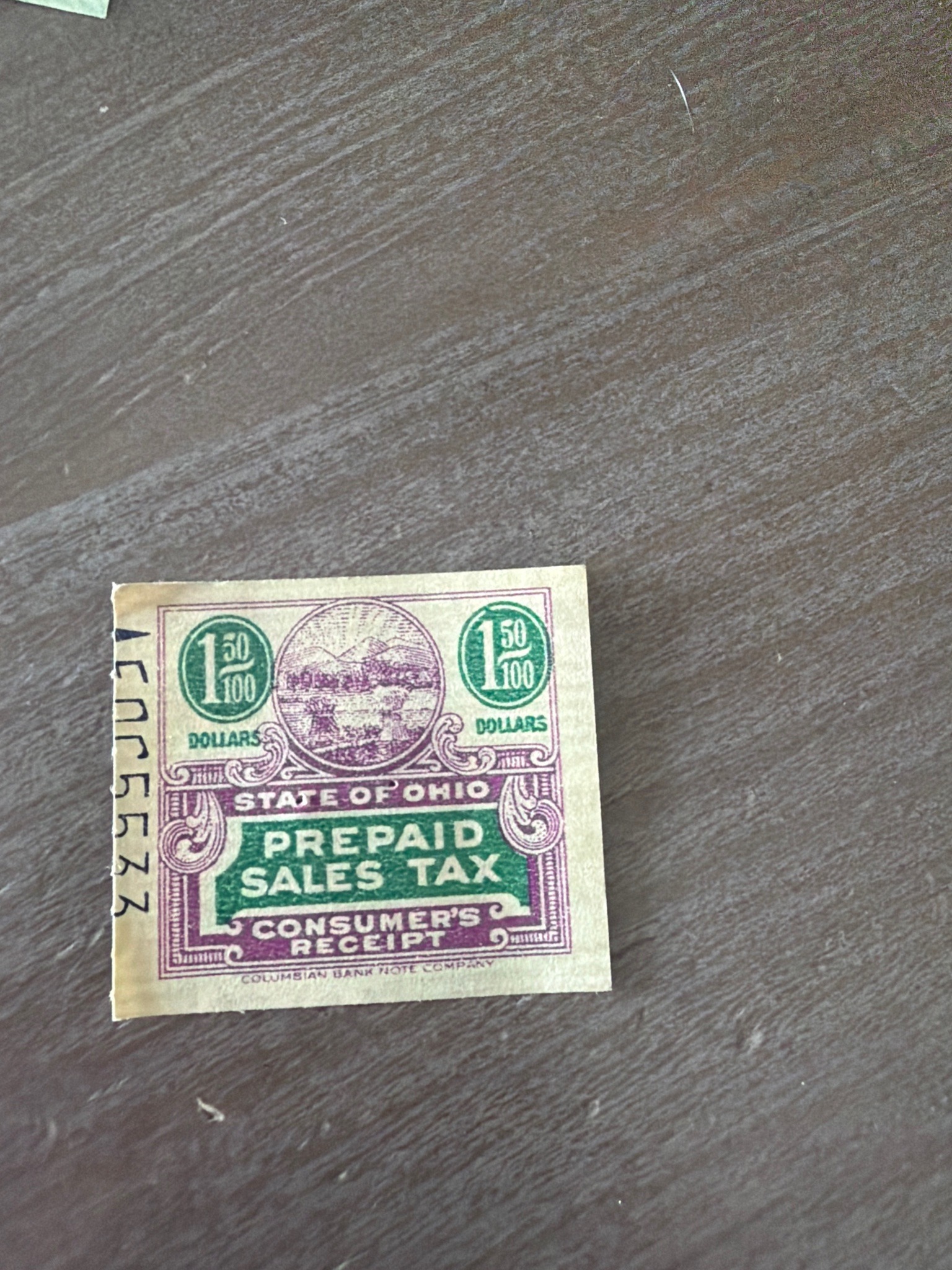
State of Ohio Prepaid Sales Tax Consumer's Receipt coupon

Ephemera and Philately

AI Estimated Value

·Not an official valuation·Verify before acting

$1 - $5

As of July 11, 2026

AI Item Analysis

·AI can make mistakes·Verify before acting
This item is a small, rectangular printed paper coupon featuring purple and green ink on an off-white or cream-colored paper background. The design is stylistically consistent with mid-20th-century tax revenue stamps used in the United States. The top portion features two circular green vignettes containing the denomination '1.50/100 DOLLARS', flanking a central purple circular vignette depicting a landscape with haystacks and a sunburst. Bold text reads 'STATE OF OHIO', 'PREPAID SALES TAX', and 'CONSUMER'S RECEIPT'. Along the bottom margin, the printer is identified as 'COLUMBIAN BANK NOTE COMPANY'. A vertical alphanumeric serial number, 'AE055533', is printed on the left margin. The item shows signs of age, including yellowing of the paper and minor surface wear, with edges that appear somewhat manually trimmed or roughly cut rather than perforated. This format is consistent with Ohio's sales tax collection system used approximately between 1935 and 1962, where retailers provided these receipts to consumers as evidence that sales tax had been prepaid. While the markings are clearly legible, the physical age and provenance of the paper remain unverified without a hands-on inspection to assess ink depth and paper composition.


AI Appraisal Report

·AI can make mistakes·Verify before acting
Based on the provided image, I am evaluating what appears to be a State of Ohio Prepaid Sales Tax Consumer's Receipt in the 1.50/100 Dollars denomination. The piece bears printing consistent with the Columbian Bank Note Company. While the alphanumeric serial number 'AE055533' and the distinct green and purple vignettes are broadly legible, I must emphasize that from a photograph alone, I cannot physically inspect the paper composition, ink depth, or printing method to rule out a reproduction. Therefore, this attribution remains a working assumption. Items of this type were widely issued in Ohio between approximately 1935 and 1962, making them relatively common in the philatelic and revenue ephemera markets. Assuming this item is of the period, the estimated market value is quite modest due to high historical production and survival rates. Comparable mid-20th-century tax receipts in mixed condition typically sell in the $1 to $5 range. The apparent yellowing, minor surface wear, and roughly cut edges noted in the visual assessment slightly impact its desirability, as specialized collectors generally prefer crisp, uncirculated examples. To properly assess its physical age and origin, an in-person examination by an ephemera specialist would be necessary. If it were found to be a modern copy or replica, the value would be strictly decorative and essentially negligible. At present, the estimate reflects what an item of this type would typically bring in the current collector market under the hypothesis that it dates to the mid-20th century.

Related Tags

Explore similar items and categories

Get your items appraised

Instant estimates of your treasures with AI-powered appraisals

Browse More Appraisals