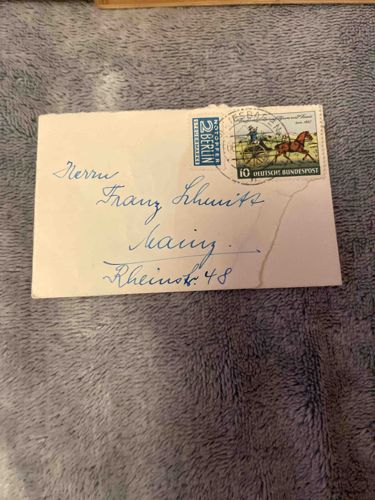
Mid-20th Century Philatelic Cover via Deutsche Bundespost
This item is a decorative philatelic cover or envelope addressed to Herr Franz Schmitt in Mainz, Rheinstr. 48. The envelope is made of a cream-colored paper stock and features handwritten cursive script in blue ink. Notably, it bears two distinct stamps in the upper right corner. The first is a 10-pfennig 'Deutsche Bundespost' stamp depicting a horse-drawn mail carriage, celebrating postal history. Adjacent to it is a blue 2-pfennig 'Notopfer Berlin' tax stamp, which was mandatory for mail in West Germany and West Berlin between 1948 and 1956 to support reconstruction. The envelope shows significant condition issues, most notably a large vertical tear running through the right side of the paper, alongside general edge wear and mild discoloration. A circular postmark from Wiesbaden is visible, dated in the 1950s, which aligns with the usage period of the tax stamp. The handwriting is fluid and characteristic of mid-century German script, indicating a personal or business correspondence from the post-war reconstruction era.
AI-Generated Appraisal Disclaimer
Estimated Value
$3.00-$7.00
Basic Information
Category
Philately and Ephemera
Appraised On
February 25, 2026
Estimated Value
$3.00-$7.00
Item Description
This item is a decorative philatelic cover or envelope addressed to Herr Franz Schmitt in Mainz, Rheinstr. 48. The envelope is made of a cream-colored paper stock and features handwritten cursive script in blue ink. Notably, it bears two distinct stamps in the upper right corner. The first is a 10-pfennig 'Deutsche Bundespost' stamp depicting a horse-drawn mail carriage, celebrating postal history. Adjacent to it is a blue 2-pfennig 'Notopfer Berlin' tax stamp, which was mandatory for mail in West Germany and West Berlin between 1948 and 1956 to support reconstruction. The envelope shows significant condition issues, most notably a large vertical tear running through the right side of the paper, alongside general edge wear and mild discoloration. A circular postmark from Wiesbaden is visible, dated in the 1950s, which aligns with the usage period of the tax stamp. The handwriting is fluid and characteristic of mid-century German script, indicating a personal or business correspondence from the post-war reconstruction era.
Get Your Items Appraised
Instant estimates of your treasures with AI-powered instant appraisals