AI estimate as of September 8, 2025 · verify with a professional before acting
AI-Generated · Verify before acting
Everything on this page is generated by AI for informational purposes only. AI can make mistakes — the AI may misidentify items or misattribute them (artist, maker, brand, designer, origin, era). This is not an official valuation and should not be used for insurance, sale, tax, estate, legal, or lending purposes — or any decision requiring a certified appraisal. It is not an authoritative claim about any person, brand, or rights holder — do not share or rely on it as a factual statement about a third party. Always consult qualified professionals before making financial decisions.
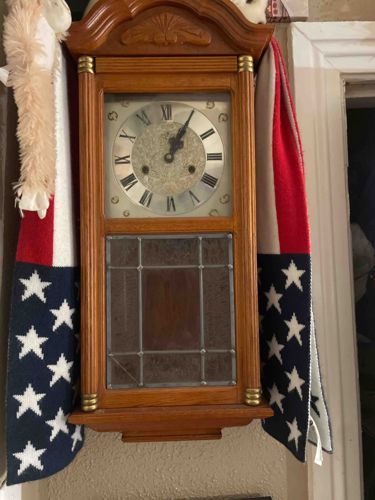
This is a rectangular wooden wall clock, likely made of oak or a similar hardwood, featuring a rich, warm brown finish. The clock's case is vertically oriented and consists of a prominent hood at the top, a central section housing the dial and door, and a projecting base at the bottom. The hood is ornately carved with a shell motif and scrolls, typical of classical or traditional furniture styles. Below the hood, the main body of the clock is flanked by reeded columns with brass-colored capitals and bases, adding a decorative touch.
The clock face is round with a silver-tone metallic finish, featuring black Roman numerals for the hours (I through XII) and minute markers around the perimeter. The center of the dial appears to have a textured or embossed pattern, possibly a floral or geometric design, which adds depth and visual interest. The hands are black and appear to be of a spade or Breguet style. Below the main clock face is a glass panel, designed to allow view of a pendulum (though none is visible in the provided image). This lower glass panel is adorned with a leaded or faux leaded glass grid pattern, forming multiple square and rectangular panes. The entire clock case is well-constructed with visible joinery and a polished surface, indicating good craftsmanship. There are no obvious signs of significant damage, cracks, or repairs, though typical dust accumulation and light surface wear consistent with age may be present. The presence of a chime is indicated by small holes on the dial, which are typical openings for silencing levers or adjustments on chiming movements. Based on its design elements, including the carved hood, reeded columns, and Roman numerals, this clock likely dates from the late 20th century, seeking to emulate earlier American or European traditional clock styles. Its functional and decorative components appear to be in good, unrestored condition.
AI Appraisal Report
Based on my visual examination of the provided image, this Traditional Wooden Wall Clock with Pendulum and Chime appears to be in good, unrestored condition. The rich, warm brown finish on the likely oak or similar hardwood case is well-preserved, showing good craftsmanship with visible joinery and a polished surface. There are no obvious signs of significant damage, cracks, or repairs, though I anticipate typical light surface wear and dust accumulation consistent with age would be found upon physical inspection. The ornate carved hood, reeded columns, and Roman numeral dial are indicative of a late 20th-century production, emulating earlier traditional styles. The presence of holes on the dial suggests a chiming mechanism.
My primary limitation in authenticity verification from an image alone is the inability to assess the internal movement. A physical examination is crucial to determine the manufacturer of the movement, its condition, and whether it is original to the case, all of which significantly impact value. I also cannot verify the presence or condition of the pendulum or chime mechanism. Provenance documentation, if available, would provide valuable historical context.
In the current market, traditional wall clocks from the late 20th century are relatively common. While this piece possesses good aesthetic qualities and appears well-maintained, it is not a rare antique. The demand for such pieces is moderate, primarily from decorators or individuals seeking functional and decorative timepieces rather than high-end collectors. Comparables in good working order typically fall within the $250-$400 range, assuming a functional and original movement. Should the movement be non-original, incomplete, or in need of substantial repair, the value would be closer to the lower end, or even less, primarily for its decorative case.