These notes were written by the person who submitted this item. Appraiser.AI has not verified them, and the AI's identification and estimate may rely on them.
AI Estimated Value
Not an official valuation
$75 - $200
AI estimate as of November 4, 2025 · verify with a professional before acting
AI-Generated · Verify before acting
Everything on this page is generated by AI for informational purposes only. AI can make mistakes — the AI may misidentify items or misattribute them (artist, maker, brand, designer, origin, era). This is not an official valuation and should not be used for insurance, sale, tax, estate, legal, or lending purposes — or any decision requiring a certified appraisal. It is not an authoritative claim about any person, brand, or rights holder — do not share or rely on it as a factual statement about a third party. Always consult qualified professionals before making financial decisions.
This analysis also relies on unverified notes provided by the user, which may be incomplete or inaccurate and could affect the result.
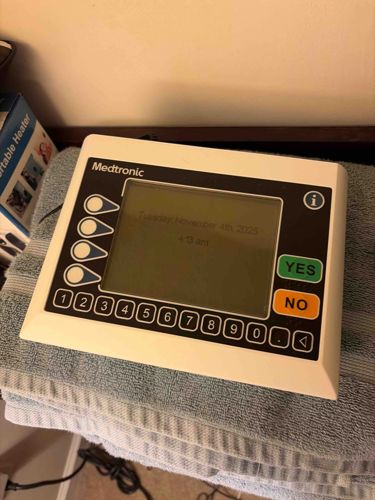
This item is a control unit for a medical device manufactured by Medtronic, a prominent company in the medical technology industry. The device features a predominantly off-white plastic casing with a black faceplate surrounding the display and control buttons. It has a rectangular shape with slightly rounded corners on the front panel. The main interface consists of a central LCD screen, currently displaying 'Tuesday, November 4th, 2025 4:13 am', indicating it's possibly a clock or scheduling function. The screen has a green-yellowish backlight, typical of older LCDs. To the left of the screen are four oval-shaped, light blue buttons with white circular centers, arranged vertically. Below the screen is a numerical keypad ranging from 0 to 9, followed by two additional buttons, one possibly for decimal input and another for backspacing or navigation (indicated by an arrow icon). To the right of the screen are two prominent rectangular buttons: a green 'YES' button and an orange 'NO' button, suggesting decision-making or confirmation functionalities. In the upper right corner of the black faceplate, there's a circular 'i' icon, likely indicating an 'information' or 'menu' button. The 'Medtronic' logo is clearly visible in the upper left corner of the black faceplate. The unit appears to be in good overall condition, with no immediate visible signs of major damage such as cracks or deep scratches on the casing or screen. There might be some minor surface wear consistent with use. Based on the screen technology and design, the device likely dates from the late 1990s to early 2010s. The craftsmanship appears to be industrial standard, robust for medical use.
AI Appraisal Report
Upon examining the provided image of the Medtronic Medical Device Control Unit, I can confirm it appears to be a genuine Medtronic product, evidenced by the clear logo. The unit presents in good visible condition, with the casing and screen appearing intact, free from obvious cracks or deep scratches. Minor surface wear, consistent with typical use over time, is likely present but not severely impacting its aesthetic or functional integrity based on the image. The green-yellowish LCD backlight and overall design language strongly suggest a manufacturing period from the late 1990s to the early 2010s, which aligns with typical product lifecycles for such medical equipment.
Assessing its market value is complex. As a control unit for a medical device, its primary value often lies in its utility within a specific medical system. Without the corresponding main device, its standalone functional value is severely limited. While Medtronic is a leading brand, this unit is likely obsolete for current medical practice. Demand for such a component would primarily come from collectors of vintage medical technology, educational institutions for display purposes, or, less likely, from individuals seeking replacement parts for very specific, older, still-functional systems. The latter is rare due to regular equipment upgrades and regulatory changes.
Comparables are difficult to pinpoint precisely due to the highly specialized nature of medical device components. Generally, obsolete standalone control units, especially without their main system, do not command high prices on the secondary market. Factors impacting value negatively include obsolescence, lack of a complete system, and potentially proprietary connectors or software that would render it inoperable outside its intended ecosystem. Positively, the Medtronic brand might offer a slight premium for collectors.
My appraisal range of $75-$200 reflects its condition and brand recognition for a niche market, assuming it's sold as a display piece or for very specific, limited parts use. This value is significantly hampered by its likely obsolescence and lack of context within a full operational system. For full authenticity and functional verification, an in-person examination, power-on testing, and ideally, documentation of its original intended use would be essential. Without physical inspection, I cannot confirm internal component integrity or full operational status.