These notes were written by the person who submitted this item. Appraiser.AI has not verified them, and the AI's identification and estimate may rely on them.
AI Estimated Value
Not an official valuation
$600-900
AI estimate as of December 15, 2025 · verify with a professional before acting
AI-Generated · Verify before acting
Everything on this page is generated by AI for informational purposes only. AI can make mistakes — the AI may misidentify items or misattribute them (artist, maker, brand, designer, origin, era). This is not an official valuation and should not be used for insurance, sale, tax, estate, legal, or lending purposes — or any decision requiring a certified appraisal. It is not an authoritative claim about any person, brand, or rights holder — do not share or rely on it as a factual statement about a third party. Always consult qualified professionals before making financial decisions.
This analysis also relies on unverified notes provided by the user, which may be incomplete or inaccurate and could affect the result.
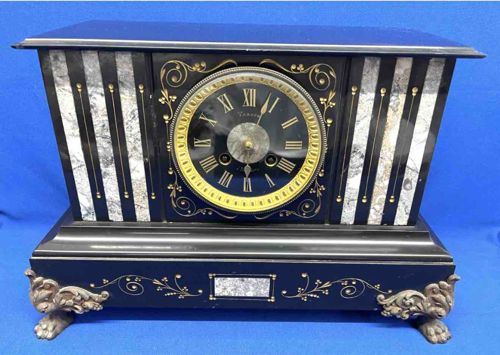
This is a substantial mantel clock, likely dating from the late 19th or early 20th century, consistent with the style of S. Marti & Cie clocks. The primary material appears to be black slate, giving it a weighty and robust appearance, contrasted beautifully with panels of white and gray speckled marble. The overall construction is rectangular, wider at the base, with tapered sides leading to a flat top. The front facade features a circular clock face inset into the slate, surrounded by intricate gilded scrollwork and floral designs. The clock face itself is black with prominent gold-colored Roman numerals (I-XII) and ornate gold hands, indicating hours and minutes. A brass or gold-painted bezel with a textured or beaded edge encircles the dial. The manufacturer's name, 'S. Marti & Cie', is visible on the dial, confirming its origin. Vertical stripes of the pale, veined marble are inlaid on either side of the central clock mechanism, further accented by small, vertical gilded studs or inserts. The base of the clock features similar gilded scrollwork and a central rectangular marble inlay, echoing the side panels. The clock stands on four ornate, cast metal feet, likely bronze or spelter with a patinated finish, styled as winged animals or mythical creatures with clawed feet. These feet exhibit some visible wear and perhaps minor corrosion consistent with age. The black slate body appears to be in good condition, with a polished finish, though minor nicks or scuffs associated with handling and age may be present upon closer inspection. The gilded accents show some signs of age-related tarnishing or minor loss, but largely retain their decorative impact. The combination of dark slate, light marble, and ornate gilding creates a classic, elegant, and somewhat imposing aesthetic, characteristic of French mantel clocks from the period. The craftsmanship, particularly the detailed inlays and cast feet, suggests a high-quality piece.
AI Appraisal Report
I've examined the S. Marti & Cie slate and marble mantel clock presented. The piece immediately strikes me as a characteristic example of late 19th to early 20th-century French clockmaking, consistent with S. Marti's prolific output. The combination of black slate, white/gray speckled marble inlays, and ornate gilded bronze/spelter elements is typical of the period and manufacturer.
Visually, the condition appears good for its age. The polished slate shows only minor scuffs or nicks, which are expected. The gilded accents, while exhibiting some tarnishing and minor loss, still contribute significantly to its aesthetic. The ornate cast feet show wear, potentially minor corrosion, consistent with age and material. The presence of 'S. Marti & Cie' on the dial strongly suggests authenticity, but without in-person inspection of the movement, detailed markings, and construction methods, absolute authenticity cannot be verified from images alone. A physical examination would allow me to assess the movement's condition, serial numbers, and compare them against known S. Marti records.
Market conditions for these types of French mantel clocks are stable. Demand is moderate, driven by collectors and individuals seeking period decorative arts. While S. Marti clocks are not exceptionally rare, quality pieces like this, with intricate marble work and well-preserved gilding, command a fair price. Comparables include similar slate and marble clocks by French makers such as Japy Freres or Vincenti. Factors impacting value positively include the detailed craftsmanship and overall good visual condition. The primary limitation is the lack of information on the internal mechanism's functionality and condition, which can significantly sway value.
To fully authenticate and determine precise value, I would ideally need to inspect the movement for originality, condition, and any signs of repair, and confirm the materials of the gilded elements.