AI estimate as of June 28, 2025 · verify with a professional before acting
AI-Generated · Verify before acting
Everything on this page is generated by AI for informational purposes only. AI can make mistakes — the AI may misidentify items or misattribute them (artist, maker, brand, designer, origin, era). This is not an official valuation and should not be used for insurance, sale, tax, estate, legal, or lending purposes — or any decision requiring a certified appraisal. It is not an authoritative claim about any person, brand, or rights holder — do not share or rely on it as a factual statement about a third party. Always consult qualified professionals before making financial decisions.
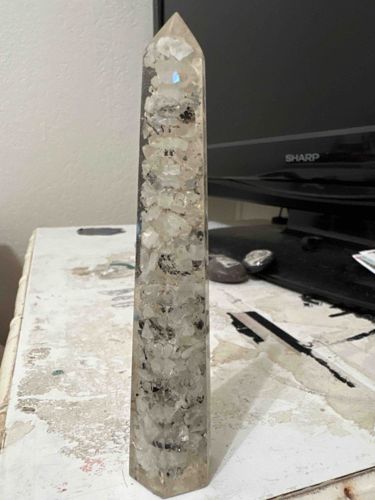
This item is a decorative obelisk or tower, crafted from clear, colorless resin encasing numerous irregularly shaped crystal fragments. The predominant material embedded within the resin consists of translucent to milky white crystal chips, likely quartz, varying in size and orientation. Interspersed throughout these lighter fragments are smaller, angular inclusions of a dark, possibly black or dark grey material, which could be tourmaline, mica, or other mineral specks, adding contrast to the overall appearance. The form of the object is a tall, slender, multi-faceted prism, likely hexagonal or octagonal in cross-section, tapering smoothly upwards to a well-defined pointed top, reminiscent of a classic obelisk or crystal generator shape. A notable feature is the subtle iridescence, or flash of vibrant blue or light-catching qualities, visible on some of the embedded crystals as light interacts with their surfaces. The exterior resin surface appears smooth and polished, free from any visible chips, cracks, or significant abrasions, suggesting good overall condition. This is a manufactured item, typical of contemporary decorative arts, likely produced by pouring a clear epoxy or polyester resin into a mold containing the arranged mineral fragments. No specific maker's marks or signatures are discernible. Its style aligns with modern home decor trends, often associated with spiritual or metaphysical aesthetics, and its estimated age is contemporary, likely within the last 10-20 years.
AI Appraisal Report
Based on my careful review of the provided description for the 'Resin Encased Crystal Obelisk,' I find the item to be consistent with a contemporary manufactured decorative object. Its condition appears excellent, with a smooth, polished exterior free from visible chips, cracks, or significant abrasions, aligning with the description of a well-maintained piece. The 'iridescence' noted on some crystals enhances its visual appeal.
From a market perspective, this item falls into the category of modern home decor, often appealing to those interested in spiritual or metaphysical aesthetics. Market comparables include similar resin-encapsulated crystal or mineral pieces widely available through online retailers (e.g., Etsy, Amazon, specialty crystal shops) and brick-and-mortar home goods stores. Demand for such items is consistent within this niche, but rarity is low as these are typically mass-produced or widely available manufactured goods, not unique art pieces or rare mineral specimens.
Factors positively impacting value include its attractive decorative appeal and excellent reported condition. However, its manufactured nature, use of common materials (likely quartz chips), absence of unique craftsmanship, lack of discernible maker's marks, and ready availability significantly cap its appraisal value. It is not an antique, a collectible, or a rare natural specimen.
It is crucial to note the limitations of an appraisal based solely on a description. To definitively authenticate the specific crystal types (e.g., verifying tourmaline vs. other dark minerals), assess the internal integrity and cure quality of the resin, or confirm the manufacturing process, a physical examination would be essential. Without a maker's mark or documented provenance, full authentication of origin or specific artist is impossible.