AI estimate as of December 13, 2025 · verify with a professional before acting
AI-Generated · Verify before acting
Everything on this page is generated by AI for informational purposes only. AI can make mistakes — the AI may misidentify items or misattribute them (artist, maker, brand, designer, origin, era). This is not an official valuation and should not be used for insurance, sale, tax, estate, legal, or lending purposes — or any decision requiring a certified appraisal. It is not an authoritative claim about any person, brand, or rights holder — do not share or rely on it as a factual statement about a third party. Always consult qualified professionals before making financial decisions.
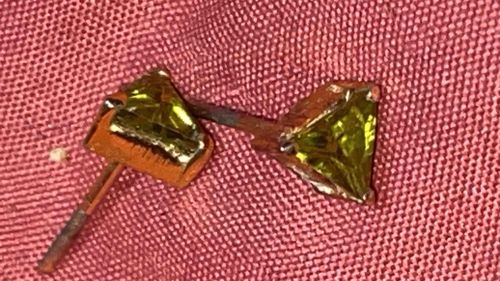
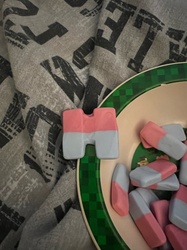
This item appears to be a miniature, hammer-shaped object displayed against a red, textured fabric background, possibly a blanket or tablecloth. The 'head' of the hammer is composed of two distinct parts. The larger portion, located on the left, is rectangular and predominantly orange-brown in color, possibly a hard candy coating or painted material. It features a visible, somewhat rough texture and what looks like a metallic, possibly gold-toned, foil-wrapped segment across its front face. This foil exhibits some crinkling, suggesting it's a wrapper or decorative element. The 'head's' right portion is triangular or wedge-shaped, entirely covered in a crinkled, shiny, greenish-gold foil. This foil also reflects light, indicating a metallic or highly reflective surface, again suggestive of a candy wrapper or similar decorative material. Both parts of the 'hammer's' head are affixed to a slender 'handle' or shaft, which is dark brown, possibly made of wood or a hard plastic, and appears worn or discolored towards its ends. The overall construction suggests a novelty item, possibly a piece of candy, a charm, or a small decorative figurine. There are no discernible manufacturer's marks or signatures. The item's condition appears relatively stable, though the foil shows crimping and the handle has some discoloration, consistent with handling or age. This object's primary appeal would likely be its diminutive size and unique, playful form. The craftsmanship points to a simple, possibly mass-produced, novelty item rather than a high-end artisanal piece. The estimated age is difficult to determine without further context, but it aligns with modern novelty candy or miniature toy aesthetics.
AI Appraisal Report
Upon visual examination of the provided image, I assess this miniature hammer-shaped object. Its condition appears stable, though the metallic foil on the 'head' shows crinkling, consistent with handling or its inherent nature as a wrapper, and the 'handle' exhibits some discoloration or wear. Authenticity as a miniature novelty item or confectionery is apparent from its design and construction; however, without physical inspection, I cannot confirm if it's a solid decorative piece, a charm, or indeed once edible candy. The materials – possible hard candy, foil, and wood/plastic – are typical for such items.
Market conditions for novelty items of this type are generally modest. Comparables would include other small, mass-produced souvenir or impulse-buy candies/toys. Demand is low, primarily driven by niche collectors of miniatures or those seeking nostalgic items. Rarity is not a significant factor; similar items are produced regularly. Factors impacting value negatively include its likely mass-produced nature, lack of discernible manufacturer's marks, and the absence of any historical significance or provenance.
Limitations in authenticity verification are significant based on images alone. To fully authenticate its original purpose (e.g., whether it was a candy), I would require in-person examination to assess material properties (e.g., sniff test for scent, gentle pressure test for fragility), and any potential packaging or provenance documentation would be crucial. Scientific testing, such as material analysis, would confirm composition but is likely overkill for an item of this type and value.