AI Appraisal Estimate

AI-generated estimates · not official valuations

From the user

What was submitted

Photo and notes provided by the user — not generated by AI

Submitted item photo
Submitted photo · June 10, 2026

User's notes

Early 1900s lamp

AI analysis below

AI appraisal

AI analysis & estimate

AI-Generated · Verify before acting

Everything below is generated by AI for informational purposes only. AI can make mistakes — the AI may misidentify items or misattribute them (artist, maker, brand, designer, origin, era). This is not an official valuation and should not be used for insurance, sale, tax, estate, legal, or lending purposes — or any decision requiring a certified appraisal. It is not an authoritative claim about any person, brand, or rights holder — do not share or rely on it as a factual statement about a third party. Always consult qualified professionals before making financial decisions.

Note

This analysis also relies on unverified notes provided by the user, which may be incomplete or inaccurate and could affect the result.

Read the full disclaimer

AI Identification

·Not independently authenticated·Verify before acting

Edwardian Era Transfer-Ware Figural Ceramic Table Lamp

Antique Lighting and Decorative Arts

AI Estimated Value

·Not an official valuation·Verify before acting

$175 - $275

As of June 10, 2026

AI Item Analysis

·AI can make mistakes·Verify before acting
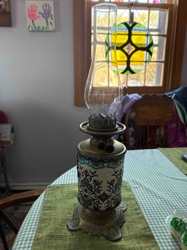
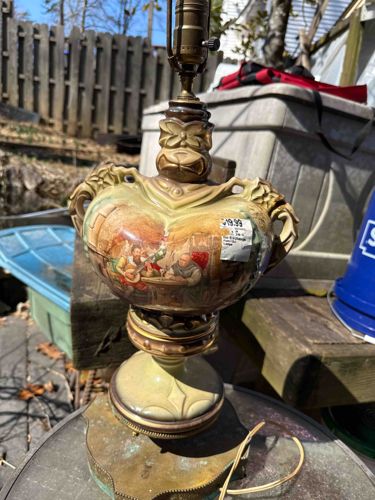
This is a decorative table lamp from the early 20th century, specifically the Edwardian or late Victorian era (circa 1900-1920). The lamp features a bulbous, urn-shaped ceramic body with ornate rococo-style handles and a pedestalled foot. The central ceramic section is decorated with a detailed transfer-ware scene depicting a tavern or alehouse interior with figures, including a man playing a lute and another seated person, rendered in a palette of warm ochres, greens, and reds. The ceramic is finished with a high-gloss glaze and accented with gilded (gold-leaf or gold-paint) scrolls and geometric molding throughout. The hardware consists of an aged brass socket and a stepped, molded metal base which shows significant greenish oxidation (verdigris) and surface wear, indicating the base is likely a lead-based white metal alloy or pot metal with a brass plating. Physical condition issues include a thrift store adhesive price tag on the ceramic body which may leave residue or damage the gilding upon removal, visible tarnishing on all metal components, and a vintage electrical cord that appears brittle and would require professional rewiring for safety. The craftsmanship is typical of mass-produced decorative lighting from the period, blending classical urn forms with popular genre painting aesthetics.

AI Appraisal Report

·AI can make mistakes·Verify before acting
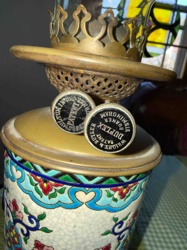
I have conducted a visual analysis of this Edwardian-era (c. 1900–1915) transfer-printed ceramic table lamp. The piece embodies the typical aesthetic of the early 20th-century decorative arts, blending a Neoclassical urn form with Rococo revival flourishes. The polychrome transfer decoration, depicting a genre-style tavern scene, suggests a manufacture by a commercial porcelain works, possibly of continental European or domestic American origin. The condition presents several challenges for valuation. While the transfer-ware remains vibrant, the extensive verdigris on the pot-metal base indicates significant environmental moisture exposure over time. Furthermore, the presence of a modern adhesive tag over the gilding and the brittle, hazardous state of the electrical components necessitates immediate professional conservation and rewiring. In the current market, decorative lighting of this type is valued primarily for its charm rather than rarity. Comparable sales for similar transfer-ware lamps in 'as-found' condition generally fall within the $150 to $300 range. The value is capped by its mass-produced nature and the cost a buyer must incur to make the item functional and safe. Limitation of Authentication: This appraisal is based solely on visual photographic evidence. To fully authenticate the piece, an in-person examination is required to identify any maker's marks under the hardware or inside the ceramic neck. Scientific testing of the metal alloy (via XRF) and removal of the base to inspect the ceramic foot for signatures would be necessary to definitively identify the kiln or foundry. Provenance documentation, such as original sales receipts or family history, could potentially enhance the item's historical value.

Get your items appraised

Instant estimates of your treasures with AI-powered appraisals

Browse More Appraisals