AI estimate as of August 27, 2025 · verify with a professional before acting
AI-Generated · Verify before acting
Everything on this page is generated by AI for informational purposes only. AI can make mistakes — the AI may misidentify items or misattribute them (artist, maker, brand, designer, origin, era). This is not an official valuation and should not be used for insurance, sale, tax, estate, legal, or lending purposes — or any decision requiring a certified appraisal. It is not an authoritative claim about any person, brand, or rights holder — do not share or rely on it as a factual statement about a third party. Always consult qualified professionals before making financial decisions.
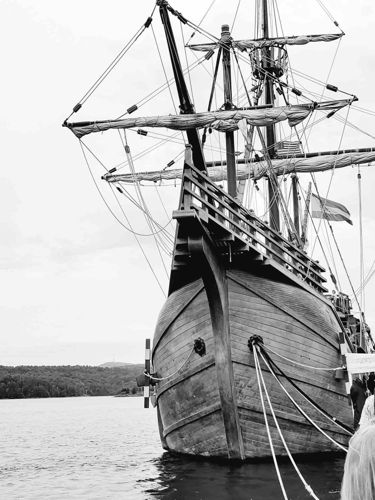
This item is a full-scale replica of a historic sailing ship, likely a carrack or galleon given its broad hull and multiple masts with square rigging visible. It is constructed primarily of wood, evident by the visible planks forming the hull, which appear to be dark in tone, possibly from staining, natural aging, or treatment. The construction shows sturdy craftsmanship with overlapping or tightly fitted planks and robust joinery. The bow is prominently featured, displaying a rounded, bulbous form indicative of early ocean-going vessels, designed for cargo capacity rather than speed. Several large, thick lines (ropes) are tied to cleats or bollards on the bow, anchoring the vessel to shore. The rigging is extensive, featuring multiple masts with horizontal spars (yards) from which sails would be unfurled (though currently furled or removed). The rigging includes numerous ropes and stays, necessary for supporting the masts and operating the sails. A foremast and at least one other mast with crow's nests are clearly visible, typical for a ship of this type. A decorative railing or bulwark is present along the deck edge, adding to the ship's period authenticity. The ship appears to be in good condition, showing typical signs of outdoor exposure on its wooden surfaces, with a natural patina that enhances its historical appearance. There are no obvious signs of significant damage or disrepair. A flag, possibly an American flag, is visible flying from the rigging in one of the closer crops, and another, unidentifiable flag, is also present. The overall impression is one of a well-maintained, historically accurate tall ship, likely used for educational purposes, tourism, or historical reenactments. The design strongly suggests a 16th or 17th-century European sailing vessel.
AI Appraisal Report
Upon visual examination of the provided images, I assess this historic tall ship replica, likely a carrack or galleon, to be in good condition. The craftsmanship appears sturdy, with robust wooden construction and extensive, period-appropriate rigging. The natural patina on the wood suggests typical outdoor exposure but no significant damage or disrepair is evident. The design strongly aligns with 16th or 17th-century European sailing vessels, indicating a high degree of authenticity in its replication efforts.
Market conditions for full-scale historic ship replicas are highly specialized. Comparables are rare, often involving custom builds or sales of existing vessels from historical foundations or museums. Demand is niche, driven by tourism, education, film production, or private collectors with significant resources. The rarity of such a large-scale, well-maintained replica significantly impacts its value. Key factors influencing value include construction quality, historical accuracy, overall condition, and operational status (if seaworthy).
My assessment of authenticity is limited to visual inspection. A full in-person examination would be crucial to verify the structural integrity of the hull and rigging, the type and condition of the timber, and the functionality of all onboard systems. Provenance documentation, including original build specifications, maintenance records, and operational history, would be essential to confirm its full authenticity and operational status. Scientific testing of wood samples could confirm timber types and age, though this is less critical for a replica.
Considering the specialized market, the apparent good condition, and the scale and historical accuracy, this vessel represents a significant asset.