AI estimate as of July 19, 2025 · verify with a professional before acting
AI-Generated · Verify before acting
Everything on this page is generated by AI for informational purposes only. AI can make mistakes — the AI may misidentify items or misattribute them (artist, maker, brand, designer, origin, era). This is not an official valuation and should not be used for insurance, sale, tax, estate, legal, or lending purposes — or any decision requiring a certified appraisal. It is not an authoritative claim about any person, brand, or rights holder — do not share or rely on it as a factual statement about a third party. Always consult qualified professionals before making financial decisions.
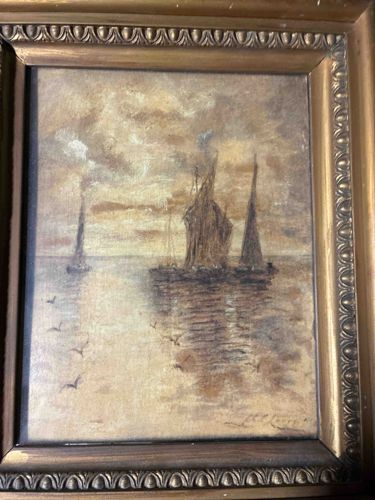
This item is an oil painting depicting a maritime scene, primarily featuring sailing vessels on a body of water under a dramatic sky. The painting appears to be framed in a substantial, possibly gilded, wooden frame with decorative molding. The canvas exhibits visible texture, suggesting an oil medium, with brushstrokes evident. The color palette is largely muted, dominated by warm yellows, browns, and grays, with hints of blue for the sky and water reflections. There are two main ships visible: one larger vessel with complex rigging and possibly furled sails, and another smaller sailboat in the distance to the left, which also seems to be a sailing boat with a triangular sail. Several birds, likely seagulls, are depicted in flight over the water in the foreground, adding an element of life to the scene. The reflections of the boats on the water are well-rendered, indicating a good understanding of light and perspective. The overall condition of the painting seems fair to good, with some visible darkening or yellowing of the varnish, consistent with age. There are no obvious tears or significant damage to the canvas itself visible in the provided image, though detailed inspection would be required to confirm. The frame shows some minor wear consistent with handling and age, including possible scuffs or small chips in the gilding, which is typical for a piece of this type. The signature of the artist is visible in the lower right corner, though it is somewhat difficult to decipher from the image provided, appearing to read 'Love' or 'L_Cress' or similar. Based on the style and apparent aging, the painting likely dates from the late 19th to early 20th century. The craftsmanship appears solid, demonstrating skilled artistic execution.
AI Appraisal Report
Based on my visual examination of the provided image, I assess this maritime seascape oil painting to be in fair to good condition, consistent with its likely age. The canvas shows a visible texture, indicating an oil medium. While there's a noticeable yellowing of the varnish, typical of older pieces, I don't observe any overt tears or significant damage to the canvas itself. The substantial, gilded frame exhibits minor wear like scuffs and chips in the gilding, which is expected. Authenticity from an image alone is limited. While the style and aging suggest a late 19th to early 20th-century origin, a definitive authentication would necessitate in-person examination to inspect the canvas, stretcher, and paint layers, as well as a more thorough analysis of the visible signature (appearing as 'Love' or 'L_Cress'). Provenance documentation, such as exhibition history or sales records, would also be crucial, and scientific testing like pigment analysis could provide further verification.
The market for 19th and early 20th-century maritime paintings remains consistently strong, especially for well-executed pieces. While this painting demonstrates good artistic skill in its composition, rendering of water, and understanding of light, the decipherability of the artist's signature is a key factor impacting its value. An established or highly collected artist would command a significantly higher price. As presented, without clear identification of the artist, this piece falls into the category of decorative fine art rather than a named collectible. Its demand is primarily driven by aesthetic appeal and its ability to complement various interior designs. Rarity is difficult to ascertain without knowing the artist's full body of work; however, maritime scenes were a popular genre. The primary value drivers are the painting's good condition for its age, its appealing subject matter, and its decorative qualities. The current market shows a steady interest in such works, particularly from buyers seeking traditional art themes. The lack of a clearly identifiable, prominent artist prevents a higher valuation.