AI Appraisal Estimate

AI-generated estimates · not official valuations

From the user

What was submitted

Photo and notes provided by the user — not generated by AI

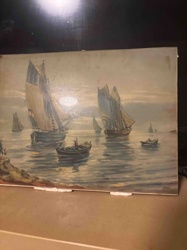
Submitted item photo
Submitted photo · May 19, 2026

User's notes

Oil painting. 1897.

AI analysis below

AI appraisal

AI analysis & estimate

AI-Generated · Verify before acting

Everything below is generated by AI for informational purposes only. AI can make mistakes — the AI may misidentify items or misattribute them (artist, maker, brand, designer, origin, era). This is not an official valuation and should not be used for insurance, sale, tax, estate, legal, or lending purposes — or any decision requiring a certified appraisal. It is not an authoritative claim about any person, brand, or rights holder — do not share or rely on it as a factual statement about a third party. Always consult qualified professionals before making financial decisions.

Note

This analysis also relies on unverified notes provided by the user, which may be incomplete or inaccurate and could affect the result.

Read the full disclaimer

AI Identification

·Not independently authenticated·Verify before acting

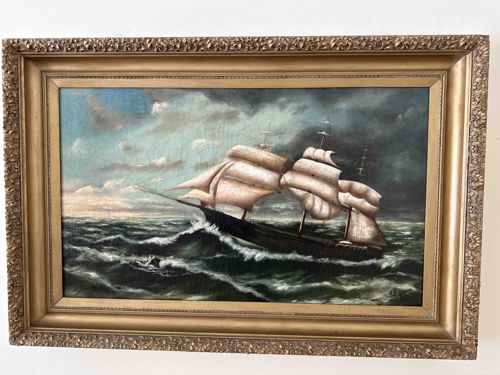
Marine Oil Painting of a Three-Masted Sailing Vessel at Sea

Fine Art - Maritime Paintings

AI Estimated Value

·Not an official valuation·Verify before acting

$4,500 - $6,500

As of May 19, 2026

AI Item Analysis

·AI can make mistakes·Verify before acting
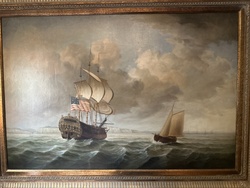
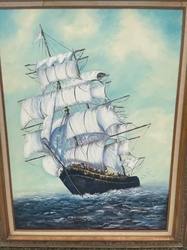
This is a dramatic maritime oil painting on canvas, dated 1897, depicting a three-masted ship, possibly a clipper or barque, navigating turbulent green and white-capped seas under a heavy, overcast sky. The composition captures the vessel at a sharp incline, highlighting the power of the ocean. Physically, the artwork is housed in a substantial, ornate gilded wood and gesso frame featuring an outer border of intricate floral or acanthus leaf moldings and a deep inner cove. The palette is dominated by deep greens, blacks, and grays in the water, contrasted by the cream-colored sails and a lighter, though stormy, horizon. Notable features include the detailed rendering of the rigging and the dynamic texture of the waves. Visible condition indicators include fine craquelure throughout the paint film, consistent with its late 19th-century age, and some minor surface grime or yellowing of the varnish. The frame shows slight wear on the gilding and minor cracking in the gesso corners. A faint monogram or signature is visible in the lower right-hand corner, though it requires further inspection to verify the artist. The quality of the draftsmanship in the vessel’s anatomy suggests an artist well-versed in nautical subjects during the height of the Romantic maritime tradition.
AI Appraisal Report

·AI can make mistakes·Verify before acting
I have conducted a visual examination of the 1897 maritime oil painting depicting a three-masted vessel. The work exhibits the hallmarks of the late Romantic maritime tradition, characterized by a dramatic use of impasto in the wave crests and a sophisticated treatment of atmospheric perspective in the overcast sky. The rigging is rendered with a high degree of technical accuracy, suggesting a practiced maritime hand. Physically, the craquelure pattern appears stable and consistent with a late 19th-century oil-on-canvas application. The ornate gilded frame, despite minor gesso loss, adds significant decorative value and is likely contemporary to the piece. The market for 19th-century marine art remains resilient, particularly for well-executed 'ship portraits' that convey high drama. Comparables for unsigned or monogrammed works of this caliber typically range between $3,000 and $8,000 at auction. The value is buoyed by the substantial framing and the large-scale composition, though it is currently limited by the lack of a verified signature. Critically, this appraisal is based on photographic evidence. A definitive attribution to a specific artist could significantly increase the value. To confirm authenticity and maximize market potential, a physical inspection is required to analyze the monogram under ultraviolet light to scan for signature enhancements. Furthermore, examining the canvas reverse for supplier stamps or provenance labels and conducting a 'stretch-test' for canvas tension would be necessary for a full authentication. Until the artist is identified via archival research or stylistic match, the valuation remains focused on its merits as a high-quality period decorative piece.

Get your items appraised

Instant estimates of your treasures with AI-powered appraisals

Browse More Appraisals