These notes were written by the person who submitted this item. Appraiser.AI has not verified them, and the AI's identification and estimate may rely on them.
AI Estimated Value
Not an official valuation
$600-1,000
AI estimate as of October 30, 2025 · verify with a professional before acting
AI-Generated · Verify before acting
Everything on this page is generated by AI for informational purposes only. AI can make mistakes — the AI may misidentify items or misattribute them (artist, maker, brand, designer, origin, era). This is not an official valuation and should not be used for insurance, sale, tax, estate, legal, or lending purposes — or any decision requiring a certified appraisal. It is not an authoritative claim about any person, brand, or rights holder — do not share or rely on it as a factual statement about a third party. Always consult qualified professionals before making financial decisions.
This analysis also relies on unverified notes provided by the user, which may be incomplete or inaccurate and could affect the result.
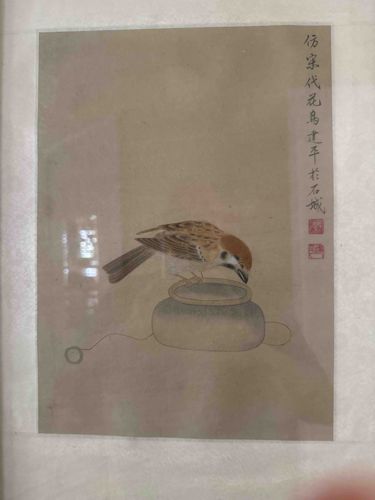
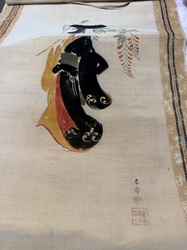
This item is a framed Chinese painting depicting a solitary sparrow perched atop a ceramic teapot. The painting is executed on what appears to be paper or fine silk, with a subtle beige or light tan background that shows signs of age and possible fading or discoloration. The sparrow is rendered with naturalistic detail, showcasing brown and reddish-brown plumage on its back and head, with lighter, possibly off-white or light gray, feathers on its belly. Its wings are depicted with intricate feather patterns, and the bird's head is tilted slightly down, suggesting it is looking into or at the teapot. The teapot itself is a soft, muted blue-gray color, with a delicate handle on one side and a thin string-like element extending from the other side, ending in a small loop. This string element suggests it might be a 'cricket pot' or a similar vessel for insects, rather than a traditional tea receptacle. The brushwork, particularly on the bird, appears fine and detailed, indicating a skilled hand. Inscriptions in traditional Chinese calligraphy are visible along the upper right side of the painting, running vertically, accompanied by two rectangular red seals, which are common for artist signatures or affirmations. The overall condition shows some visible creasing or ripples in the paper, particularly in the lower left quadrant, and the background color is not entirely uniform, hinting at age-related wear or environmental exposure. The framing is simple, with a white or off-white matting and a light-colored frame, but the focus is clearly on the artwork itself. The style suggests a traditional Chinese bird-and-flower (Huaniaohua) genre, possibly from the late 19th to early 20th century, drawing inspiration from classical Song dynasty styles given the meticulous detail.
AI Appraisal Report
Upon examining the details of this framed Chinese painting depicting a sparrow on what appears to be a 'cricket pot,' I observe a piece characteristic of the traditional Chinese bird-and-flower (Huaniaohua) genre. The meticulous brushwork on the sparrow, particularly the detailed feather patterns, suggests a skilled artist with an understanding of naturalistic rendering, drawing parallels to classical Song dynasty aesthetics often revisited in later periods. The calligraphy and red seals are crucial elements, indicative of traditional Chinese painting practices for artist identification and affirmation. However, solely from images, I cannot definitively authenticate the seals or the calligraphy's authorship without expert in-person analysis.
The condition, with visible creasing, ripples in the paper, and non-uniform background discoloration, suggests age and potential exposure issues. While these factors detract slightly from pristine condition, they are also consistent with the estimated age of late 19th to early 20th century. My appraisal is based on the artistic merit of the painting, demonstrating good execution and subject matter appealing to collectors of traditional Chinese art. Market demand for well-executed, appealing examples of Huaniaohua remains stable, particularly for pieces that convey a sense of age and authenticity, even if not by a renowned master. Similar unsigned or less documented works of this quality typically fetch values in the $600-$1,000 range at auction or through reputable dealers.
For full authentication and a more precise valuation, an in-person examination is paramount to assess the paper or silk quality, pigment stability, and to identify the artist through the seals and calligraphy. Moreover, tracing provenance documentation, if available, would significantly enhance its value. Scientific testing could also verify the age of the materials. Without these, my appraisal is based on visual characteristics and comparative market knowledge of similar works, acknowledging limitations in definitive authentication from imagery alone.