AI estimate as of November 18, 2025 · verify with a professional before acting
AI-Generated · Verify before acting
Everything on this page is generated by AI for informational purposes only. AI can make mistakes — the AI may misidentify items or misattribute them (artist, maker, brand, designer, origin, era). This is not an official valuation and should not be used for insurance, sale, tax, estate, legal, or lending purposes — or any decision requiring a certified appraisal. It is not an authoritative claim about any person, brand, or rights holder — do not share or rely on it as a factual statement about a third party. Always consult qualified professionals before making financial decisions.
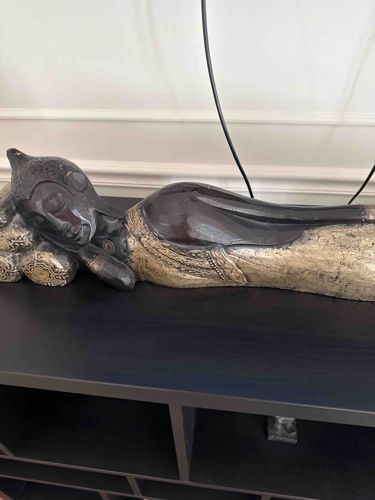
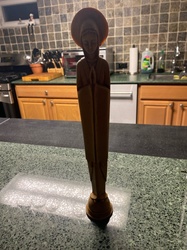
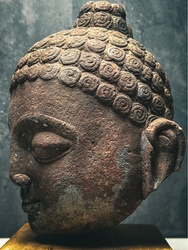
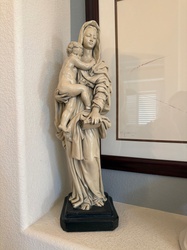
This item is a decorative reclining Buddha statue, depicting the Buddha in his final illness, just before entering Parinirvana. The statue is relatively elongated, suggesting a significant length, possibly ranging from 2 to 3 feet based on its placement on the furniture. The materials appear to be carved wood for the darker, more prominent features like the head, upper torso, and draped arm, combined with a textured, lighter-colored material for the lower body and pillow, which could be gilded or painted gesso over wood or a composite material. The color palette primarily consists of a dark, rich brown or black for the Buddha's hair, face, and upper garment, contrasting with a distressed, antique gold or cream color for the pillow and the lower, more textured portion of the body, which extends into the lower drapery. The 'pillow' features intricate, circular, mandala-like patterns in gold, suggesting a higher level of detail and craftsmanship. The Buddha's face is serene, with closed eyes and a gentle smile, characteristic of many Buddhist representations. The top of the head features an ushnisha, indicating wisdom and spiritual enlightenment. The condition appears good from the visible angle, with no obvious major damage, although the lighter-colored areas show a distressed or aged patina, which might be intentional to simulate age or a result of natural wear. The construction details suggest multiple pieces or sections joined together, particularly where the dark and light sections meet. The overall style is consistent with Southeast Asian Buddhist art, though without specific manufacturing marks, a precise regional origin or exact age is difficult to determine. It likely serves as a spiritual or decorative home accent, indicating a period of decorative art rather than extreme antiquity.
AI Appraisal Report
Upon visual examination of the provided image, I have assessed this Southeast Asian-style Reclining Buddha statue. The piece, estimated at 2-3 feet in length, appears to be constructed from mixed materials, likely carved wood for the head and torso combined with a gilded or painted gesso/composite for the lower body and base. The condition is good for a decorative item, with an intentionally distressed or aged patina on the gilded sections, which is common for contemporary reproductions meant to simulate antiquity. There is no visible damage like cracks or chips.
This style of statue is widely produced for the home decor and spiritual goods market. While the craftsmanship shows some nice detail, particularly in the patterned base, it does not exhibit the unique characteristics or superlative quality of a genuine antique or a master-carved piece. The market for such decorative Buddhist art is quite saturated. Comparable mass-produced, mixed-media reclining Buddha statues of this size and quality typically sell in the low to mid-hundreds.
The primary factor limiting the value is its likely status as a 20th or 21st-century decorative reproduction rather than a religious antique. Its value is derived from its aesthetic and decorative appeal, not historical or artistic rarity.
It is crucial to note the limitations of this appraisal. Without physical inspection, I cannot confirm the materials, age, or country of origin. A definitive authentication would require in-person examination to study tool marks and material composition, along with a review of any provenance documentation. However, based on the visual evidence, it is most consistent with a modern decorative piece, and my valuation reflects this assessment.