AI Appraisal Estimate

AI-generated estimates · not official valuations

From the user

What was submitted

Photo and notes provided by the user — not generated by AI

Submitted item photo
Submitted photo · June 20, 2026

User's notes

No additional notes provided.

AI analysis below

AI appraisal

AI analysis & estimate

AI-Generated · Verify before acting

Everything below is generated by AI for informational purposes only. AI can make mistakes — the AI may misidentify items or misattribute them (artist, maker, brand, designer, origin, era). This is not an official valuation and should not be used for insurance, sale, tax, estate, legal, or lending purposes — or any decision requiring a certified appraisal. It is not an authoritative claim about any person, brand, or rights holder — do not share or rely on it as a factual statement about a third party. Always consult qualified professionals before making financial decisions.

Read the full disclaimer

AI Identification

·Not independently authenticated·Verify before acting

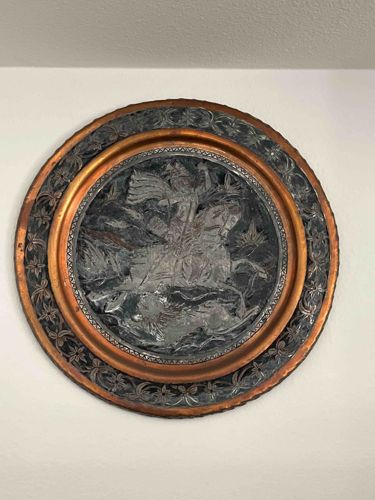
Tinned Copper Wall Platter Depicting Saint George and the Dragon

Antique and Vintage Metalware

AI Estimated Value

·Not an official valuation·Verify before acting

$250 - $450

As of June 20, 2026

AI Item Analysis

·AI can make mistakes·Verify before acting
This is a large, circular decorative wall platter featuring a central repoussé scene of Saint George on horseback slaying the dragon. The item is constructed from copper that has been selectively tinned to create a two-tone aesthetic. The central medallion is heavily tinned, giving it a cool, silvery-grey appearance that contrasts sharply against the warm, reddish-orange hue of the exposed copper border. The relief work in the center shows the knight in traditional armor with a flowing cape, mounted on a rearing horse, and brandishing a spear toward a fallen dragon at the base. This central scene is surrounded by multiple decorative registers: first, a fine geometric or 'sawtooth' patterned band; next, a wide, smooth copper band; and finally, an outer perimeter rim decorated with chased and engraved floral and foliate vine motifs on a darkened ground. The outer edge is finished with a scalloped or crimped detail. Regarding condition, the piece shows significant patina consistent with mid-20th-century age, including localized oxidation, darkening of the copper, and minor surface scratches. The tinning shows some uneven wear, particularly on high-relief points. This style of metalwork is characteristic of Greek, Armenian, or Persian craft traditions, often created for the souvenir or folk art market between 1940 and 1970. The level of detail in the engraving suggests a high degree of hand-craftsmanship rather than modern mechanical stamping.

AI Appraisal Report

·AI can make mistakes·Verify before acting
I have conducted a visual examination of the tinned copper wall platter depicting Saint George and the Dragon. Based on the repoussé technique and the specific two-tone aesthetic, I identify this as a mid-20th-century piece (circa 1940-1960), likely originating from a Greek or Armenian workshop specializing in traditional folk motifs. The craftsmanship is high; the hand-chased foliate borders and the depth of the central relief indicate a skilled artisan rather than mass-produced mechanical stamping. The condition is consistent with age, displaying a desirable patina. While the slight wear on the tinning at high-relief points is present, it does not detract significantly from the decorative appeal, though the localized oxidation on the copper border suggests storage in a humid environment. Market demand for mid-century religious and folkloric metalware remains steady, particularly among collectors of Byzantine-style iconographic art. Comparable pieces of this scale (largely decorative wall plates exceeding 14 inches) typically realize between $200 and $500 at specialty auctions. The Saint George motif is a perennially popular subject, which bolsters its liquidity in the secondary market. Limitations: This appraisal is based solely on digital imagery. To provide a definitive authentication, I would require an in-person inspection to verify the weight of the copper and search for hidden maker's marks or hallmarks on the reverse. Scientific testing to confirm the exact composition of the tin alloy and provenance documentation regarding its history of ownership would be necessary to elevate this piece from 'Mid-Century Folk Art' to a 'Provenanced Antique,' which could potentially increase the valuation.

Get your items appraised

Instant estimates of your treasures with AI-powered appraisals

Browse More Appraisals