AI Appraisal Estimate

AI-generated estimates · not official valuations

From the user

What was submitted

Photo and notes provided by the user — not generated by AI

Submitted item photo
Submitted photo · May 19, 2026

User's notes

No additional notes provided.

AI analysis below

AI appraisal

AI analysis & estimate

AI-Generated · Verify before acting

Everything below is generated by AI for informational purposes only. AI can make mistakes — the AI may misidentify items or misattribute them (artist, maker, brand, designer, origin, era). This is not an official valuation and should not be used for insurance, sale, tax, estate, legal, or lending purposes — or any decision requiring a certified appraisal. It is not an authoritative claim about any person, brand, or rights holder — do not share or rely on it as a factual statement about a third party. Always consult qualified professionals before making financial decisions.

Read the full disclaimer

AI Identification

·Not independently authenticated·Verify before acting

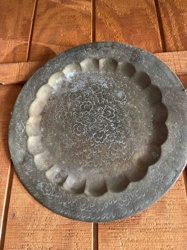
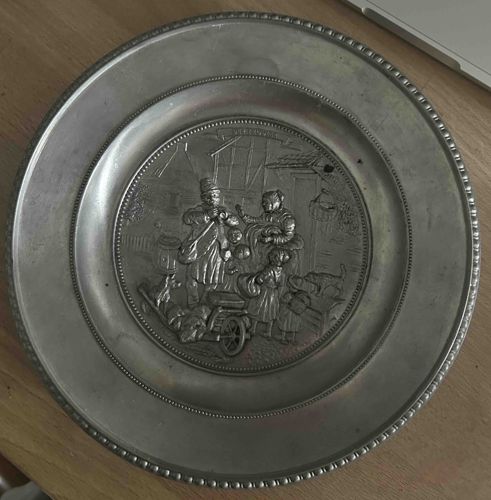
Vintage Embossed Pewter Commemorative Plate with Village Scene

Antique and Vintage Metalware

AI Estimated Value

·Not an official valuation·Verify before acting

$45 - $75

As of May 19, 2026

AI Item Analysis

·AI can make mistakes·Verify before acting
This is a circular decorative plate made of pewter, likely of European (possibly Dutch or German) origin, following the traditional style of 20th-century commemorative metalware. The plate features a wide, flat rim decorated with a beaded or 'gadroon' edge. The center well is deeply embossed with a detailed narrative scene depicting a village tableau, likely representational of a historical trade or town activity. Characters in period-style clothing are visible, including a man with a cart, a woman, and children near a timber-framed building. The metal exhibits a dull, leaden gray patina characteristic of aged pewter, with visible surface oxidation and localized darkening. Construction is likely sand-cast or pressed, with the high-relief central medallion showing significant depth. Notable condition issues include minor surface scratching, small dark spots (pitting) consistent with environmental exposure, and a slight unevenness in the rim's curvature. Above the central scene, there is a small rectangular cartouche which typically would contain a name or date, though the text appears worn or faded. The craftsmanship reflects mid-tier industrial reproduction of classic 17th or 18th-century forms, commonly used as souvenir wall hangings or display cabinet pieces.
AI Appraisal Report

·AI can make mistakes·Verify before acting
Based on my visual examination of the vintage embossed pewter plate, I have determined it to be a decorative souvenir piece likely dating from the mid-20th century. The piece mimics the aesthetics of 17th-century Dutch 'Kast' plates but lacks the weight, sharp detail, and touchmarks associated with true antique pewter from the 1600s or 1700s. The 'gadroon' rim and the village scene—likely a market day or blacksmithing tableau—show hallmarks of industrial pressing or sand-casting rather than hand-chasing. The dull patina and localized pitting are consistent with a lead-pewter alloy subjected to household oxidation. The market for mid-century European commemorative pewter is currently saturated. While charming, these items were mass-produced for the tourism and giftware markets. Comparable sales on platforms such as eBay and Etsy consistently show realized prices between $30 and $80 for similar 9-inch to 12-inch plates. The worn cartouche, which usually indicates a specific town or event, limits the appeal for specialized collectors who seek identifiable provenance. Significantly impacting the value is the lack of a visible maker's mark (angel marks or touchmarks) on the reverse, which often differentiates high-quality German workshops from standard giftware. Limitations to this digital appraisal include the inability to perform a 'ping' test for lead content or a weight assessment to distinguish between solid pewter and pewter-plated base metal. A full authentication would require a physical inspection of the back for hallmarks and a metallurgical test to confirm the alloy composition. Provenance documentation, such as a purchase record from a known gallery or estate, would be necessary to elevate the valuation above the standard decorative range.

Get your items appraised

Instant estimates of your treasures with AI-powered appraisals

Browse More Appraisals