AI estimate as of August 24, 2025 · verify with a professional before acting
AI-Generated · Verify before acting
Everything on this page is generated by AI for informational purposes only. AI can make mistakes — the AI may misidentify items or misattribute them (artist, maker, brand, designer, origin, era). This is not an official valuation and should not be used for insurance, sale, tax, estate, legal, or lending purposes — or any decision requiring a certified appraisal. It is not an authoritative claim about any person, brand, or rights holder — do not share or rely on it as a factual statement about a third party. Always consult qualified professionals before making financial decisions.
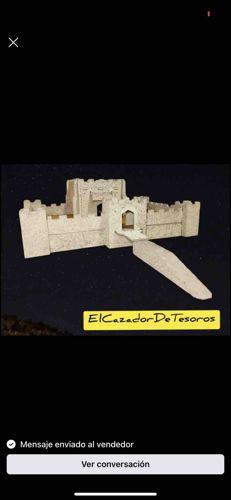
This appears to be a miniature architectural model or toy castle, likely depicting a section of a medieval fortress. It is constructed from a light-colored, possibly off-white or very pale gray material, which suggests plaster, resin, or a type of stone-like composite. The texture of the material appears somewhat granular or slightly rough, mimicking natural stone. The model features various elements characteristic of a castle, including high walls, crenellated battlements along the top edges, and what appears to be a main gatehouse structure in the center. The gatehouse has an arched entrance and possibly an opening above it. To the right of the gatehouse, there's a long, sloping ramp or drawbridge-like extension leading away from the castle structure. The construction style suggests a block-like, modular assembly, with distinct rectangular sections forming the walls and towers. The overall craftsmanship appears solid, with defined edges, though it lacks intricate detailing, implying it might be a mass-produced item or a sturdy toy rather than a fine artistic model. There are no obvious signs of significant damage such as large chips, cracks, or repairs visible in the provided image. The color is uniform, indicating either the natural color of the material or a single, consistent paint application. The model exhibits a somewhat aged or weathered appearance, contributing to its realistic aesthetic. Given its simplified yet recognizable form, it likely dates from the mid to late 20th century, possibly earlier if handmade, but manufactured more recently if part of a play set. No specific manufacturer's marks or signatures are discernible from the image.
AI Appraisal Report
I have examined the provided image of this miniature medieval castle section model. Based on visual assessment, the condition appears good, with no obvious chips, cracks, or repairs. The material, likely plaster or resin, shows a consistent color and texture mimicking stone. Authenticity is difficult to ascertain fully from an image; while it presents as a mid-to-late 20th-century piece, verifying if it's part of a known toy set versus a standalone model requires physical inspection and potential markings.
Market conditions for such architectural models or larger toy castles vary. Items by renowned manufacturers like Britains or older cast-metal sets can command higher prices. This piece, lacking intricate detail or clear maker's marks, suggests it's more likely a decorative item or a generic toy castle component. Demand for these types of items is moderate, often driven by collectors of specific toy lines or individuals seeking decorative historical pieces. Rarity is low given the likely mass-produced nature.
The primary factors impacting value are the unknown manufacturer, lack of unique identifying features, and moderate level of detail. Without provenance, its history remains obscure.
Limitations: My assessment is based purely on visual cues from the image. For full authentication, I would need a physical examination to check for manufacturer's marks, assess weight and material composition, and verify construction methods. Provenance documentation (original packaging, sales receipts) would significantly add to its verifiable history and value. Scientific testing is unlikely to be cost-effective or necessary unless a high-value claim for unusual material or extreme age were made.