These notes were written by the person who submitted this item. Appraiser.AI has not verified them, and the AI's identification and estimate may rely on them.
AI Estimated Value
Not an official valuation
$80-120
AI estimate as of November 19, 2025 · verify with a professional before acting
AI-Generated · Verify before acting
Everything on this page is generated by AI for informational purposes only. AI can make mistakes — the AI may misidentify items or misattribute them (artist, maker, brand, designer, origin, era). This is not an official valuation and should not be used for insurance, sale, tax, estate, legal, or lending purposes — or any decision requiring a certified appraisal. It is not an authoritative claim about any person, brand, or rights holder — do not share or rely on it as a factual statement about a third party. Always consult qualified professionals before making financial decisions.
This analysis also relies on unverified notes provided by the user, which may be incomplete or inaccurate and could affect the result.
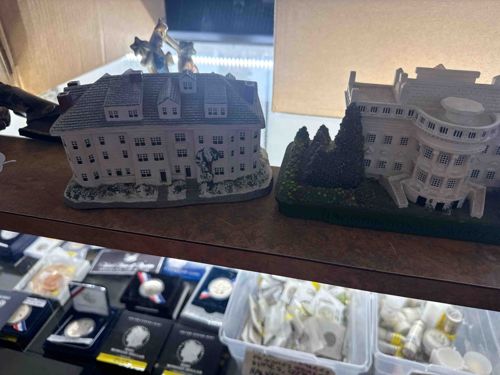
This lot features two distinct miniature architectural models, likely crafted from resin or a similar polymer composite, and hand-painted. The item on the left is a highly detailed replica of what appears to be the Norman Rockwell Museum. It showcases a multi-story building with a light beige or off-white facade, numerous windows across multiple floors, and a prominent gray shingled gambrel roofline with multiple dormer windows. Subtle architectural details such as window frames, door outlines, and textured siding are visible. The base of this model is painted in shades of gray to simulate a paved or gravel path surrounded by green landscaping. The item on the right is a miniature representation of The White House, specifically depicting the Executive Residence with its recognizable curved portico and multiple columns. This model is predominantly white with gray accents for windows and roofing. It is set upon a green base that mimics a grassy lawn, featuring several dark green, conical trees to the left of the structure. Both models demonstrate a good level of craftsmanship in their molding and painting, aiming for realistic architectural fidelity. There are no obvious signs of significant damage such as chips, cracks, or repairs, though some minor dust accumulation is visible, suggesting they have been displayed. The overall condition appears to be good with a clean, if slightly aged, patina. No specific manufacturing marks or signatures are discernible from the provided images. These models likely belong to a collection of significant American landmarks, potentially sold as souvenirs or decorative items.
AI Appraisal Report
Upon visual examination of the provided images, I find this collection of miniature architectural models, featuring the Norman Rockwell Museum and The White House, to be in good overall condition. The craftsmanship appears competent, with fine detailing in the molding and hand-painting. There are no readily apparent chips, cracks, or repairs, though minor dust accumulation suggests display. Authenticity, in terms of being genuine replicas rather than unique art pieces, appears consistent with typical souvenir or decorative models of landmarks. While the models are detailed, their composition (likely resin or polymer composite) and lack of discernible manufacturer marks or signatures suggest they are mass-produced decorative items rather than artist-signed or limited-edition sculptures.
Market conditions for such architectural models indicate a steady, albeit niche, demand among collectors of landmark souvenirs or decorative miniatures. While specific exemplars like these are not extraordinarily rare, well-maintained pieces like these do hold appeal. Comparables for similar resin models of significant American buildings typically range from $30-$60 per model, depending on size, detail, and perceived quality. The inclusion of both the Norman Rockwell Museum and The White House in one lot adds a slight premium due to the combined appeal.
Factors significantly impacting value here include the good condition, the recognizable subjects, and the apparent quality of the hand-painting. However, the mass-produced nature (implied by material and lack of unique identifiers) limits the top-end value. Without physical inspection, I cannot confirm the exact material composition, true scale, or identify any subtle manufacturing marks that might be present on the underside. A full authentication would require in-person examination to verify material, assess the true extent of any wear or dust, and search for manufacturer details not visible in images.