These notes were written by the person who submitted this item. Appraiser.AI has not verified them, and the AI's identification and estimate may rely on them.
AI Estimated Value
Not an official valuation
$750 - $950
AI estimate as of September 21, 2025 · verify with a professional before acting
AI-Generated · Verify before acting
Everything on this page is generated by AI for informational purposes only. AI can make mistakes — the AI may misidentify items or misattribute them (artist, maker, brand, designer, origin, era). This is not an official valuation and should not be used for insurance, sale, tax, estate, legal, or lending purposes — or any decision requiring a certified appraisal. It is not an authoritative claim about any person, brand, or rights holder — do not share or rely on it as a factual statement about a third party. Always consult qualified professionals before making financial decisions.
This analysis also relies on unverified notes provided by the user, which may be incomplete or inaccurate and could affect the result.
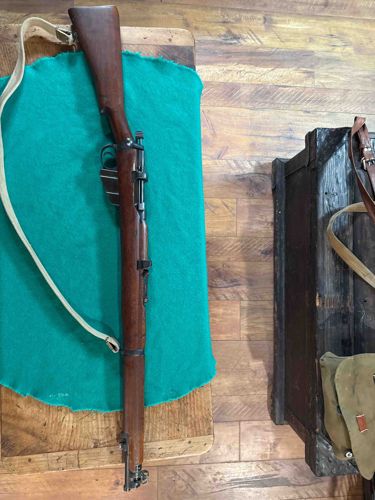
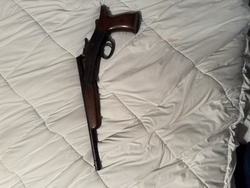
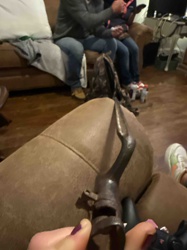
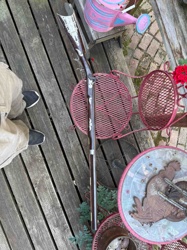
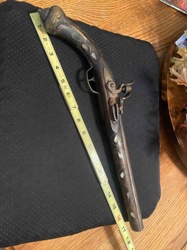
The item is a bolt-action rifle, specifically identified by the context as a 1920 Lithgow SHT.LE* (Short Magazine Lee-Enfield MkIII*, likely a No. 1 Mk III*). It features a full-length wooden stock, appearing to be made of a dark-stained hardwood, possibly walnut or similar, exhibiting a rich, dark brown hue. The wood shows some areas of lighter tone, indicative of wear or possibly a different grain pattern. The metal components, including the barrel, receiver, bolt, and magazine, appear to be blued steel, now displaying a worn patina with some areas of silvering or surface corrosion visible, particularly on the magazine and around the muzzle area. The rifle is equipped with a detachable box magazine, characteristic of the Lee-Enfield design. A canvas or webbing sling, light tan or off-white in color, is attached to the rifle, running from the buttstock to the front sling swivel. The furniture appears largely intact, though some nicks, scratches, and dings are visible on the wooden stock, consistent with its age and intended use as a military rifle. The buttstock features a straight grip. The rear sight appears to be the standard tangent leaf sight. Given the 1920 manufacturing date, the rifle is from the inter-war period, shortly after its widespread use in World War I, and carries the robust, utilitarian craftsmanship expected of a military-issue firearm of that era. There are no overt signs of major structural damage, but the overall condition suggests significant use and handling over its lifespan. The markings '1920 Lithgow SHT.LE*' confirm its manufacturer, model, and year of production.
AI Appraisal Report
Upon examining the provided images and description of this 1920 Lithgow SMLE No. 1 Mk III*, I have assessed its condition and market value. The rifle presents as a genuine example of Australian inter-war production. The wooden stock, likely coachwood, exhibits characterful wear with various dings, scratches, and a rich patina consistent with a service rifle over a century old. The metal components show a corresponding patina, with bluing loss and some silvering, which is expected and does not significantly detract from its value for a military collectible. The '1920 Lithgow SHT.LE*' markings appear consistent with known examples from this period.
The market for WWI-era and inter-war Lee-Enfield rifles remains strong, with a particular interest in non-British Commonwealth productions like Lithgow. Demand is driven by collectors and historical firearms enthusiasts. Comparable Lithgow SMLEs from this era in similar, well-used but all-original condition typically trade in the $750 to $950 range. The rifle's value is significantly enhanced by what appears to be its original, as-issued configuration without modern sporterization or major replacement parts.
However, this appraisal is limited by the use of images alone. For full authentication, an in-person examination is crucial. I would need to check for matching serial numbers on the receiver, bolt, barrel, and stock to confirm it isn't a 'parts gun'. Verifying the bore condition (sharpness of rifling, absence of pitting) is also critical to value, especially for shooters. Finally, disassembly would be required to inspect for any hidden proof marks or import stamps that could impact its collector status.