AI estimate as of October 29, 2025 · verify with a professional before acting
AI-Generated · Verify before acting
Everything on this page is generated by AI for informational purposes only. AI can make mistakes — the AI may misidentify items or misattribute them (artist, maker, brand, designer, origin, era). This is not an official valuation and should not be used for insurance, sale, tax, estate, legal, or lending purposes — or any decision requiring a certified appraisal. It is not an authoritative claim about any person, brand, or rights holder — do not share or rely on it as a factual statement about a third party. Always consult qualified professionals before making financial decisions.
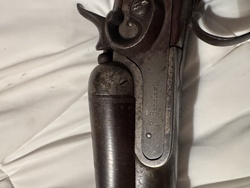
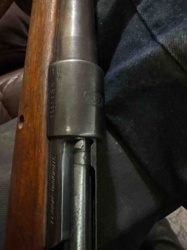
The item appears to be an antique firearm lock mechanism, specifically from a muzzleloading rifle or pistol. It is constructed entirely of metal, likely steel or wrought iron, which has developed a dark, heavily oxidized patina consistent with age and exposure, ranging from deep brown to black. The visible components include the hammer, which features a pointed tip designed to strike the frizzen, and a portion of the frizzen itself, which would pivot to expose the pan. The hammer shows a somewhat stylized, subtly curved form. Attached to the lock plate (the majority of which is obscured) are visible small screws or pins, indicating its assembly. A distinct, squared-off component protrudes from the side, which could be part of the tumbler or a safety mechanism. The overall condition suggests significant age and usage, as evidenced by the heavy patina and what appears to be minor surface pitting, though no major breaks or repairs are immediately discernible from this view. The craftsmanship, while functional, reflects a period where such components were often hand-forged or cast. Based on its design characteristics and apparent oxidation, this piece likely dates from the 18th or 19th century, before more modern cartridge-based firing mechanisms became prevalent. Its raw, unpolished state indicates it is a component part, possibly recovered from an old firearm or as a standalone collectible.
AI Appraisal Report
Having carefully reviewed the provided image of this antique muzzleloader lock with its hammer and frizzen assembly, I can offer the following appraisal. The item presents as a well-patinated, all-metal component, likely steel or wrought iron, exhibiting a deep brown to black oxidation consistent with considerable age and exposure. The visible hammer has a pointed tip, and a portion of the frizzen is discernible, along with assembly screws. A squared-off component protrudes, suggesting part of the internal mechanism. The overall condition indicates significant age and usage, with minor surface pitting but no immediately apparent major breaks or repairs. This craftsmanship aligns with an 18th or 19th-century origin, prior to the widespread adoption of cartridge firing systems. Its raw state confirms it as a component rather than a complete firearm.
Authenticity, based purely on visual examination, appears high for a period firearm component; the wear and patina are difficult to replicate convincingly. However, without physical examination, I cannot definitively rule out modern reproduction with artificial aging. Factors impacting value significantly include its incomplete nature; it is a lock assembly, not a whole firearm. Market demand for standalone antique firearm components is generally moderate, attracting specialist collectors or restorers rather than broad antique enthusiasts. Comparables on the market for similar period lock assemblies in this condition typically range from $100-$300. Demand for such components is niche, and its rarity is moderate – these parts are not uncommon but finding them in good, unrestored condition is becoming less frequent.
For full authentication, a physical examination would be crucial to assess metallurgical composition, internal mechanism wear (which could indicate a level of usage), and the precise nature of the patination. Microscopic analysis could differentiate genuine age from artificial aging. Provenance documentation, such as records of its recovery or prior ownership, would also significantly enhance its verifiable authenticity and, consequently, its market value. Without these, my appraisal remains largely based on visual inference and general market trends for similar items.