AI Appraisal Estimate

AI-generated estimates · not official valuations

From the user

What was submitted

Photo and notes provided by the user — not generated by AI

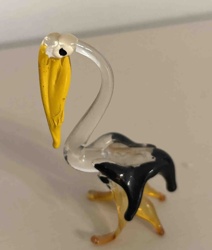
Submitted item photo
Submitted photo · June 27, 2026

User's notes

No additional notes provided.

AI analysis below

AI appraisal

AI analysis & estimate

AI-Generated · Verify before acting

Everything below is generated by AI for informational purposes only. AI can make mistakes — the AI may misidentify items or misattribute them (artist, maker, brand, designer, origin, era). This is not an official valuation and should not be used for insurance, sale, tax, estate, legal, or lending purposes — or any decision requiring a certified appraisal. It is not an authoritative claim about any person, brand, or rights holder — do not share or rely on it as a factual statement about a third party. Always consult qualified professionals before making financial decisions.

Read the full disclaimer

AI Identification

·Not independently authenticated·Verify before acting

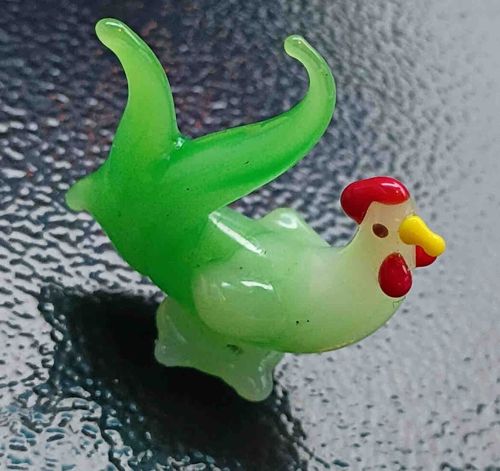
Miniature Hand-Blown Green Glass Rooster Figurine

Art Glass / Collectible Miniatures

AI Estimated Value

·Not an official valuation·Verify before acting

$15.00 - $25.00

As of June 27, 2026

AI Item Analysis

·AI can make mistakes·Verify before acting
This item is a micro-miniature figurine of a rooster, meticulously crafted using the lampwork glass technique. The piece is constructed from translucent and opaque glass in a vibrant palette of emerald green, pale lime, red, and yellow. The body features a gradient effect, transitioning from a milky pale green at the breast to a deep, saturated green throughout the prominent, upright tail feathers. Notable physical features include a trio of stylized tail plumes curved backwards, a bright red comb and wattle, a tiny yellow beak, and dark dot eyes. The figurine stands approximately 1 to 1.5 inches in height. The craftsmanship suggests it was created by heating glass rods over a torch (lampworking) and hand-shaping the molten material without the use of molds, making each iteration slightly unique. In terms of condition, the glass appears to be in excellent vintage state with no visible fractures, chips, or internal stress cracks. There are no discernible maker's marks or signatures, which is common for such small-scale art glass. Based on the style and material, this piece likely originates from the mid-to-late 20th century, consistent with collectible glass miniatures popularized by studios in Murano, Italy, or similar artisan workshops in Asia. The fluid curves and delicate balance of the tail assembly indicate a high level of artisanal skill for its scale.
AI Appraisal Report

·AI can make mistakes·Verify before acting
I have conducted a visual examination of the micro-miniature lampwork rooster figurine. The piece exhibits high-quality craftsmanship characteristic of mid-to-late 20th-century artisan glasswork. The saturation of the emerald green glass and the delicate application of the red comb and wattle suggest a skilled hand, likely following the Murano tradition or high-end export workshops in Asia. The condition appears near-mint; I observe no evidence of 'glass disease,' impact fractures, or surface abrasions, which are common risks for such delicate protrusions as the tail plumes. The market for unsigned glass miniatures is currently stable but highly saturated. Comparables, such as Wade Whimsies or unsigned Venetian miniatures, frequently trade in the $10 to $30 range. The value is driven primarily by its aesthetic appeal and the complexity of the lampwork rather than brand or maker rarity. Factors impacting value include the lack of a maker's mark and its small scale, which limits its appeal to a niche segment of miniature collectors. Limitations: It is important to note that a definitive assessment of the glass's origin and age cannot be verified through digital imagery alone. A physical inspection under UV light would be required to check for fluorescence that might indicate specific glass compositions, and a high-magnification loupe would be necessary to identify any microscopic stress cracks at the join points of the tail and body. Provenance or an original studio box would be required to justify a premium valuation above the current estimate.

Get your items appraised

Instant estimates of your treasures with AI-powered appraisals

Browse More Appraisals