These notes were written by the person who submitted this item. Appraiser.AI has not verified them, and the AI's identification and estimate may rely on them.
AI Estimated Value
Not an official valuation
$4,000-6,000
AI estimate as of December 11, 2025 · verify with a professional before acting
AI-Generated · Verify before acting
Everything on this page is generated by AI for informational purposes only. AI can make mistakes — the AI may misidentify items or misattribute them (artist, maker, brand, designer, origin, era). This is not an official valuation and should not be used for insurance, sale, tax, estate, legal, or lending purposes — or any decision requiring a certified appraisal. It is not an authoritative claim about any person, brand, or rights holder — do not share or rely on it as a factual statement about a third party. Always consult qualified professionals before making financial decisions.
This analysis also relies on unverified notes provided by the user, which may be incomplete or inaccurate and could affect the result.
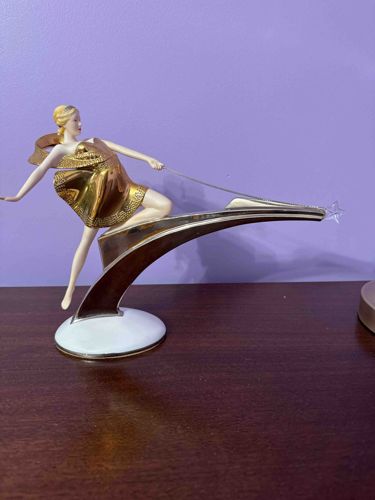
This appears to be the 'Rhapsody' sculpture by Erte (Romain de Tirtoff), a renowned Art Deco artist. The item depicts a stylized female figure, possibly crafted from cold-painted bronze or a similar composite material, with a cream-colored 'skin' tone for the exposed body parts (face, arms, legs) and blonde hair pulled back. She is draped in a flowing, metallic gold gown or fabric, which exhibits intricate patterned detailing along its edges, indicative of Art Deco stylization. The figure is dynamically posed, seemingly gliding or flying, with one leg extended backward and the other knee bent forward. Her left arm is extended, holding what appears to be a thin string or ribbon that leads to a star-shaped ornament at the very end of the 'glide' element. The figure is mounted on a sleek, aerodynamic, and curved support structure that forms the 'glider' or 'ski'. This support piece is primarily bronze-colored with silver or chrome-colored accents along its top edge, suggesting a polished metal finish. The entire sculpture rests on a white, oval-shaped base with a thin gold or bronze trim around its periphery. The craftsmanship is highly detailed, characteristic of Erte's work, emphasizing elegance, movement, and the Art Deco aesthetic. No visible damage such as chips, cracks, or significant wear is apparent from the images, suggesting good to excellent condition. The metallic finishes appear well-preserved, and the cold-painted areas show no obvious flaking. This piece embodies the glamour and sophistication of the Art Deco period, likely dating from the late 20th century, corresponding to Erte's later works.
AI Appraisal Report
Based on my visual examination of the provided image, this Erte 'Rhapsody' bronze sculpture appears to be in excellent condition. The cold-painted 'skin' tones show no observable flaking, and the metallic finishes, particularly the intricate gold gown and the bronze/silver glider, are well-preserved with no apparent corrosion or significant wear. The detail work, including the patterned edging on the gown and the star ornament, is sharp and consistent with Erte's known aesthetic and craftsmanship. Authenticity, based solely on imagery, is strongly suggested by the distinctive Art Deco stylization, the characteristic elongated female form, and the dynamic movement typical of Erte's works from the late 20th century. However, definitive authentication without physical inspection is limited. I would need to physically examine the piece for foundry marks, edition numbers, Erte's signature, and any certificates of authenticity that typically accompany such limited-edition works. Scientific testing of the materials could also confirm their composition and age.
The market for Erte's bronze sculptures remains robust, driven by steady demand from Art Deco collectors and enthusiasts. 'Rhapsody' is one of his more recognizable and sought-after pieces, contributing to its value. While not exceedingly rare, a well-preserved example, especially one from a lower edition number, can command premium prices. Factors significantly impacting value include the authenticated signature, the edition number (lower numbers are generally more desirable), and the overall condition, where this piece excels visually. Provenance documentation, detailing the item's ownership history, would also add significant credibility and value. Considering its apparent pristine condition and the established market for Erte's work, I estimate its current fair market value to be in the range of $4,000-6,000.