AI estimate as of September 1, 2025 · verify with a professional before acting
AI-Generated · Verify before acting
Everything on this page is generated by AI for informational purposes only. AI can make mistakes — the AI may misidentify items or misattribute them (artist, maker, brand, designer, origin, era). This is not an official valuation and should not be used for insurance, sale, tax, estate, legal, or lending purposes — or any decision requiring a certified appraisal. It is not an authoritative claim about any person, brand, or rights holder — do not share or rely on it as a factual statement about a third party. Always consult qualified professionals before making financial decisions.
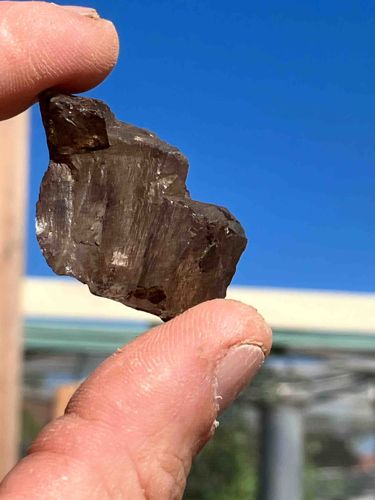
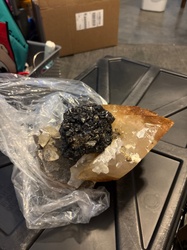
The item is a raw, unpolished specimen of what appears to be smoky quartz, held between the thumb and forefinger of a person. It is relatively small, likely fitting comfortably within the palm of a hand. The crystal exhibits a translucent to semi-transparent quality, allowing some light to pass through, and its color ranges from a medium to dark brown, characteristic of smoky quartz. There are clear facets and natural cleavage planes visible on its surface, indicating an unworked, natural state. The surfaces appear somewhat uneven and rough, with some areas showing a more glassy or vitreous luster where light reflects off the natural crystal faces. There are no obvious signs of significant damage such as large chips or cracks, suggesting a relatively intact specimen, though minor nicks from extraction or handling are possible. No specific maker's marks, signatures, or stamps are discernible on this natural mineral. The form is amorphous and irregular, typical of a naturally occurring crystal fragment rather than a cut or polished gem. The apparent clarity and color suggest a fair to good quality natural crystal, suitable for a mineral collection or as a raw material for lapidary work. Its age is geological, having formed naturally over millions of years.
AI Appraisal Report
Based on my visual examination of the provided image, this specimen is unequivocally a raw, unpolished smoky quartz crystal. Its translucent quality and characteristic medium to dark brown coloration confirm its identity. The visible natural facets and cleavage planes, along with the uneven, rough surfaces, are consistent with an unworked, naturally formed mineral fragment. I observe no signs of significant damage such as large chips or major cracks, suggesting a relatively intact specimen, though minor nicks from extraction or handling are common and appear minimal here. The clarity and color appear fair to good for a natural, unpolished piece.
From a market perspective, raw smoky quartz, particularly in this size and quality range, is generally abundant. It is a common mineral frequently available from various sources, including rock shops, online retailers, and mineral shows. Therefore, its rarity is low, and demand, while steady for collectors and hobbyists, is not exceptionally high for unexceptional specimens. Comparative examples of similar-sized raw smoky quartz pieces typically retail within a modest price bracket. Factors impacting its value include its natural, aesthetic form, and the absence of significant damage. Due to the high availability of comparable items, the market for such pieces is quite competitive.
It is crucial to note the limitations of authenticating solely from images. While the visual characteristics strongly suggest smoky quartz, a definitive authentication would ideally involve in-person examination to assess properties like hardness, specific gravity, and luster more accurately. Confirmation of its natural, unenhanced state would also benefit from closer inspection for treatments (e.g., irradiation for color). No specific provenance documentation was provided, which, if available, could add value, especially if it points to a renowned locality. Scientific testing, such as X-ray diffraction, would confirm its crystalline structure, though this is rarely performed or necessary for common minerals like quartz unless authenticity is deeply questioned.