AI estimate as of September 12, 2025 · verify with a professional before acting
AI-Generated · Verify before acting
Everything on this page is generated by AI for informational purposes only. AI can make mistakes — the AI may misidentify items or misattribute them (artist, maker, brand, designer, origin, era). This is not an official valuation and should not be used for insurance, sale, tax, estate, legal, or lending purposes — or any decision requiring a certified appraisal. It is not an authoritative claim about any person, brand, or rights holder — do not share or rely on it as a factual statement about a third party. Always consult qualified professionals before making financial decisions.
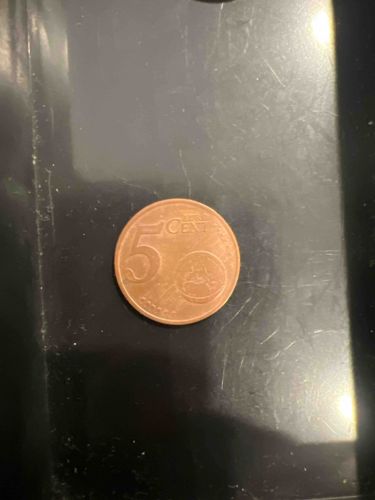
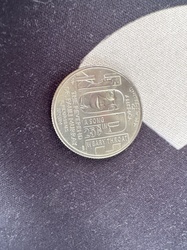
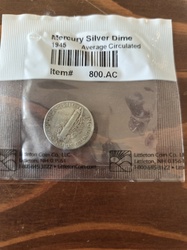
The item is a round, copper-colored coin, appearing to be a 5 Euro Cent coin. The obverse side is clearly visible, featuring a large numeral '5' to the left, indicating its denomination. To the right of the numeral '5', the word 'CENT' is embossed horizontally. Below the 'CENT' inscription, there is a representation of the globe, specifically depicting Africa and parts of Europe and Asia, which is characteristic of the common side of Euro cent coins from 2007 onwards. The coin's surface shows signs of wear consistent with circulation, including minor scratches and a slightly dulled luster, indicating it is not a pristine, uncirculated specimen. The overall condition suggests a typical circulated example, with no apparent major damage such as bends, significant dents, or corrosion. The relief of the design elements, while visible, does not appear exceptionally sharp, which is also typical for circulated coinage. The edges are not visible in this image but would typically be smooth for this denomination. The material is evidently copper-plated steel, giving it its distinctive reddish-brown hue. The craftsmanship aligns with modern mass-produced coinage, focusing on durability and consistent design rather than intricate artisanal detail. Given the visible design, it can be confidently placed in the contemporary period, specifically from the early 21st century after the adoption of the Euro.
AI Appraisal Report
Based on my visual examination of the provided image, this 5 Euro Cent coin is an authentic, circulated example. The design elements, including the large '5', 'CENT' inscription, and the globe depicting Europe and Africa, are consistent with the common side of Euro cent coins issued from 2007 onwards. The copper-colored appearance accurately reflects its composition as copper-plated steel.
The condition is typical for a circulated coin, exhibiting minor scratches, dull luster, and some wear on the high points, which collectively place it in the 'Very Fine' to 'Extremely Fine' range, though a precise numerical grade cannot be assigned from an image alone. There are no signs of significant damage like bends, corrosion, or major dings that would severely detract from its value. The relief is visible but not exceptionally sharp, as expected for a coin that has been in circulation.
Market conditions for common euro coinage, particularly low denominations like the 5 Euro Cent, are generally low. These coins are produced in massive quantities across numerous mints within the Eurozone, making them exceptionally common. Demand from collectors for circulated examples is minimal, typically limited to those looking to complete a basic set by country/year without regard for high-grade specimens. Rarity is not a factor for this item; it is a mass-produced modern circulating currency.
The primary factor impacting its value is its status as common circulating currency. Its numismatic value only marginally exceeds its face value, if at all, unless it were an uncirculated example of a rare year or mint mark, which is not discernible nor suggested by its condition.
Limitations: While authenticity seems clear from the image, an in-person examination would be required for definitive authentication. This would involve inspecting the edge, weight, diameter, and thickness, and scrutinizing specific die characteristics under magnification to rule out sophisticated counterfeits (though highly unlikely for such a low-value coin). Provenance documentation is not applicable here given its nature as a common circulating coin. Scientific testing would only be necessary in cases of suspected metallurgical anomalies or advanced counterfeiting, neither of which is indicated here.