AI estimate as of August 9, 2025 · verify with a professional before acting
AI-Generated · Verify before acting
Everything on this page is generated by AI for informational purposes only. AI can make mistakes — the AI may misidentify items or misattribute them (artist, maker, brand, designer, origin, era). This is not an official valuation and should not be used for insurance, sale, tax, estate, legal, or lending purposes — or any decision requiring a certified appraisal. It is not an authoritative claim about any person, brand, or rights holder — do not share or rely on it as a factual statement about a third party. Always consult qualified professionals before making financial decisions.
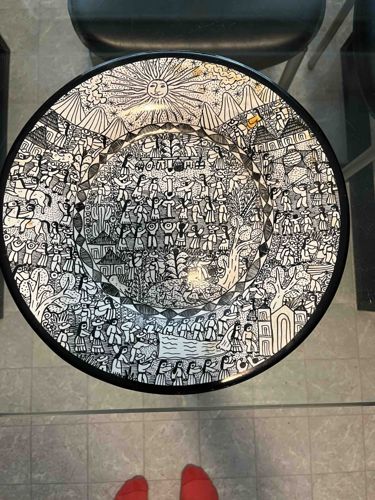
This item is a round table with a glass top featuring an intricate, hand-painted or printed design underneath. The artwork is monochromatic, primarily in black and white, depicting a densely populated, lively scene reminiscent of folk art or naive art. The central motif appears to be a large community with numerous figures engaged in various activities, surrounded by stylized natural elements like trees and mountains, and architectural structures. A prominent smiling sun with radiating rays is visible at the top of the design, suggesting an outdoor, possibly pastoral or village setting. The artistic style is characterized by heavy outlining, repetitive patterns, and a 'horror vacui' approach, where nearly every space is filled with detail. The overall composition shows a central circular design, with a distinct border or frame surrounding the main narrative. There are no visible maker's marks or signatures in the provided image. The glass surface appears smooth and largely free of significant scratches, indicating good preservation of the artwork beneath. The edges of the table are black, providing a strong contrast to the white elements of the design. The table base itself is not clearly visible, but the glass top appears to be substantial, possibly indicating a modern construction. The piece demonstrates a high degree of detailed craftsmanship in the artwork, suggesting it is either a unique artisanal creation or a part of a limited production series. The design has a timeless, story-telling quality often found in traditional or indigenous art forms.
AI Appraisal Report
Based on my visual examination of the Folk Art Motif Glass Top Table, the piece appears to be in excellent condition. The glass surface seems smooth and largely free of scratches that would obscure the artwork, which is notable for a functional item. The artwork itself, a monochromatic, densely detailed folk art scene, shows no apparent fading, chipping, or other damage from the provided image. The "horror vacui" style, with its heavy outlining and repetitive patterns, is characteristic of naive or outsider art, giving it a unique aesthetic appeal.
Authenticity is a key consideration. From the image, it is impossible to definitively determine if the artwork is hand-painted directly onto the table surface, printed, or a decoupage application. The level of detail suggests either exceptionally fine hand-painting or a high-quality print. This impacts value significantly; a unique, hand-painted artwork would command a higher price than a mass-produced print. Without visible maker's marks or signatures, a precise attribution is impossible.
In terms of market conditions, decorative tables with unique artistic elements, especially those evoking folk or outsider art, find a niche market. Comparables would include artist-designed furniture, vintage painted tables, and contemporary art furniture. Demand for unique, conversation-piece items is generally steady, though not reaching the heights of established fine art. The rarity of this specific design, particularly if it's a one-off artisanal creation, would significantly enhance its value.
Factors impacting value include the actual medium of the artwork (hand-painted vs. print), the artist's identity (if known), provenance, and the quality/material of the table base (which is not visible). Given the unique aesthetic, I believe it has strong decorative appeal.
For full authentication, a physical inspection would be crucial to determine the artwork medium (paint layers vs. print texture), assess the hidden table base, and search for faint signatures or manufacturer's marks. Provenance documentation, such as purchase receipts or artist information, would be invaluable. Without these, my appraisal is based solely on visual characteristics and market generalities for similar artistic decorative objects.