These notes were written by the person who submitted this item. Appraiser.AI has not verified them, and the AI's identification and estimate may rely on them.
AI Estimated Value
Not an official valuation
$40 - $70
AI estimate as of September 18, 2025 · verify with a professional before acting
AI-Generated · Verify before acting
Everything on this page is generated by AI for informational purposes only. AI can make mistakes — the AI may misidentify items or misattribute them (artist, maker, brand, designer, origin, era). This is not an official valuation and should not be used for insurance, sale, tax, estate, legal, or lending purposes — or any decision requiring a certified appraisal. It is not an authoritative claim about any person, brand, or rights holder — do not share or rely on it as a factual statement about a third party. Always consult qualified professionals before making financial decisions.
This analysis also relies on unverified notes provided by the user, which may be incomplete or inaccurate and could affect the result.
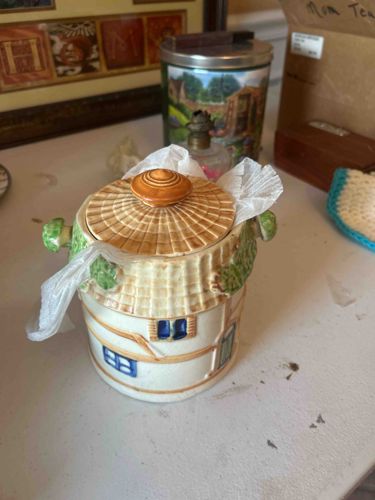
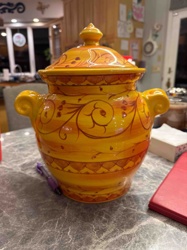
This is a whimsical ceramic lidded jar, likely a honey pot or preserve jar, produced by the KSP Pottery Company in England. The item is designed to resemble a charming thatched cottage, exhibiting a cream-colored body for the walls with horizontal bands painted in a warm brown to mimic timber framing. The lid is a focal point, molded and painted to represent a thatched roof, with a radial pattern in varying shades of brown and tan, topped by a small, spherical finial in a solid, lighter tan or caramel color. Integrated into the cottage design are molded details depicting windows with blue frames and panes, and a doorway, possibly in a greenish-blue hue, adding to its picturesque aesthetic. Around the top rim of the body and extending slightly up towards the roof section, there are molded and painted green elements that suggest foliage or climbing vines, enhancing the cottage theme. Two small, ear-shaped handles on opposite sides of the jar also feature these green foliage details. The overall construction appears to be molded ceramic with hand-painted details, characteristic of decorative pottery. Visible condition shows some protective tissue paper still tucked around the lid, suggesting it's either newly acquired, packed for storage, or has been well-preserved. There are no immediate visible chips, cracks, or significant wear on the glazed surface, indicating good to excellent condition. The craftsmanship suggests a charming, decorative piece, likely from the mid-20th century to late 20th century, consistent with English cottage ware pottery.
AI Appraisal Report
I have carefully examined the provided image and information for this KSP Pottery Company Thatched Cottage Honey Pot or Preserve Jar. Based on visual assessment, the condition appears to be excellent, with no immediately visible chips, cracks, or significant wear. The presence of protective tissue paper further suggests careful handling or storage. Authenticity to KSP Pottery Company, England, is consistent with the style and reported markings. The craftsmanship, particularly the molded details of the cottage, thatched roof, and hand-painted accents, is characteristic of decorative English cottage ware from the mid-to-late 20th century.
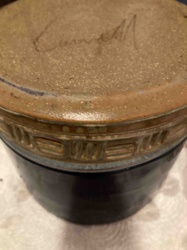
In terms of market conditions, items like this KSP cottage ware typically reside in the collector's market for decorative pottery. Demand is generally moderate, driven by collectors of specific pottery brands, cottage-themed decor, or those seeking nostalgic kitchenware. While charming, these items are not exceptionally rare. Comparable sales for KSP Pottery cottage-themed jars and teapots in excellent condition on platforms like eBay or Etsy typically range from $30 to $80, depending on the specific design, size, and condition. Factors impacting value include the excellent preservation, the detailed and appealing design, and its potential as a display piece. Without a physical inspection, I cannot confirm the absence of hairline cracks, crazing, or repairs that might be less visible in images. A tactile examination would also verify the ceramic quality and glaze consistency. Furthermore, provenance documentation or a close-up examination of any maker's marks would fully authenticate the KSP origin, though it appears credible from the information provided.