AI estimate as of October 7, 2025 · verify with a professional before acting
AI-Generated · Verify before acting
Everything on this page is generated by AI for informational purposes only. AI can make mistakes — the AI may misidentify items or misattribute them (artist, maker, brand, designer, origin, era). This is not an official valuation and should not be used for insurance, sale, tax, estate, legal, or lending purposes — or any decision requiring a certified appraisal. It is not an authoritative claim about any person, brand, or rights holder — do not share or rely on it as a factual statement about a third party. Always consult qualified professionals before making financial decisions.
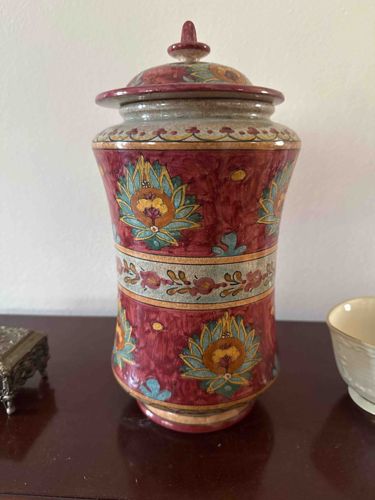
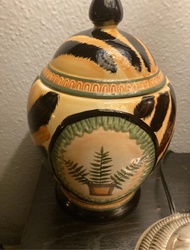
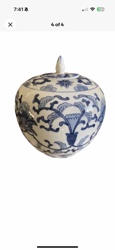
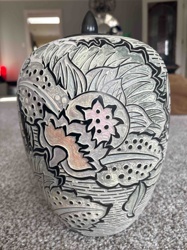
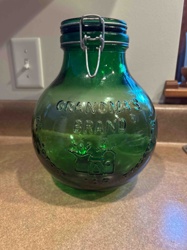
This is a decorative lidded jar, likely ceramic or pottery, featuring a vibrant polychrome design. The item has a classical urn-like silhouette with a slightly flared base, a gently curving body that narrows slightly towards the top, and a distinct neck, topped by a domed lid with a finial handle. The primary color scheme consists of a rich, mottled reddish-brown or burgundy hue that serves as the background for painted floral motifs. The floral designs appear to be stylized lotus or peony blossoms, rendered in shades of teal, light blue, orange, yellow, and red, outlined in a darker color, possibly gold or brown. These large floral elements are interspersed with smaller, lighter yellow dot accents. Two horizontal bands encircle the central part of the jar: a wider band above and a narrower band below, both painted in a light blue or gray hue with a repeating pattern of scrolled foliage or abstract floral elements in reddish-brown, green, and yellow tones. The neck of the jar and the rim of the lid feature a lighter, possibly gray or beige color, accented with a scalloped or scale-like pattern in the same color palette as the rest of the jar. The finial of the lid is bulbous with a pointed tip, continuing the reddish-brown coloration. The craftsmanship suggests hand-painting, given the slight variations in color intensity and brushstrokes. No visible chips, cracks, or significant wear are immediately apparent from the image, indicating good condition, though a closer inspection would be needed to confirm. The glossy finish suggests a glazed surface. The overall style evokes an antique or vintage aesthetic, possibly influenced by Asian or Mediterranean decorative art, dating perhaps from the mid-20th century or earlier due to its elaborate, hand-decorated nature. The gold-toned outlines potentially suggest an earlier manufacturing period or a higher-quality decorative technique. The jar serves primarily as a decorative accent piece or a functional storage container.
AI Appraisal Report
Upon visual examination of this Polychrome Floral Lidded Jar, I note its classical urn-like silhouette and vibrant hand-painted floral motifs. The condition appears to be very good, with no visible chips, cracks, or significant wear evident from the image, which suggests careful handling over time. The glossy glazed finish is intact. The polychrome decoration, featuring stylized lotus or peony blossoms in teal, blue, orange, yellow, and red, outlined in what appears to be gold or brown, indicates a decorative piece with an antique or vintage aesthetic. The craftsmanship, particularly the variations in brushstrokes, points to hand-painting, enhancing its appeal.
Market conditions for decorative ceramic or pottery jars of this style are generally stable. Comparable pieces with similar elaborate hand-painted designs and good condition typically fall within a modest price range, unless definitively attributed to a renowned maker or specific historical period. Demand for such items is consistent among collectors of vintage decorative arts, though it is not considered exceptionally rare.
Factors significantly impacting value include the perceived era of manufacture (likely mid-20th century or earlier), the quality of the hand-painting, and its well-preserved state. The gold-toned outlines, if genuine, would indicate a higher-quality decorative technique. However, it is crucial to note the limitations of image-based appraisal. While the piece appears authentic as a vintage decorative item, without physical examination, I cannot definitively confirm the material (ceramic vs. pottery), the exact composition of the pigments (e.g., real gold vs. gold-tone paint), or the absence of hairline cracks or repairs not visible in the provided image. A thorough in-person inspection would allow for tactile assessment, a more accurate determination of material and decorative technique, and a search for maker’s marks. Provenance documentation or scientific testing (e.g., thermoluminescence for dating) would be necessary for full authentication and to potentially identify a specific origin or artist, which could significantly impact its value.