These notes were written by the person who submitted this item. Appraiser.AI has not verified them, and the AI's identification and estimate may rely on them.
AI Estimated Value
Not an official valuation
$250 - $450
AI estimate as of October 12, 2026 · verify with a professional before acting
AI-Generated · Verify before acting
Everything on this page is generated by AI for informational purposes only. AI can make mistakes — the AI may misidentify items or misattribute them (artist, maker, brand, designer, origin, era). This is not an official valuation and should not be used for insurance, sale, tax, estate, legal, or lending purposes — or any decision requiring a certified appraisal. It is not an authoritative claim about any person, brand, or rights holder — do not share or rely on it as a factual statement about a third party. Always consult qualified professionals before making financial decisions.
This analysis also relies on unverified notes provided by the user, which may be incomplete or inaccurate and could affect the result.
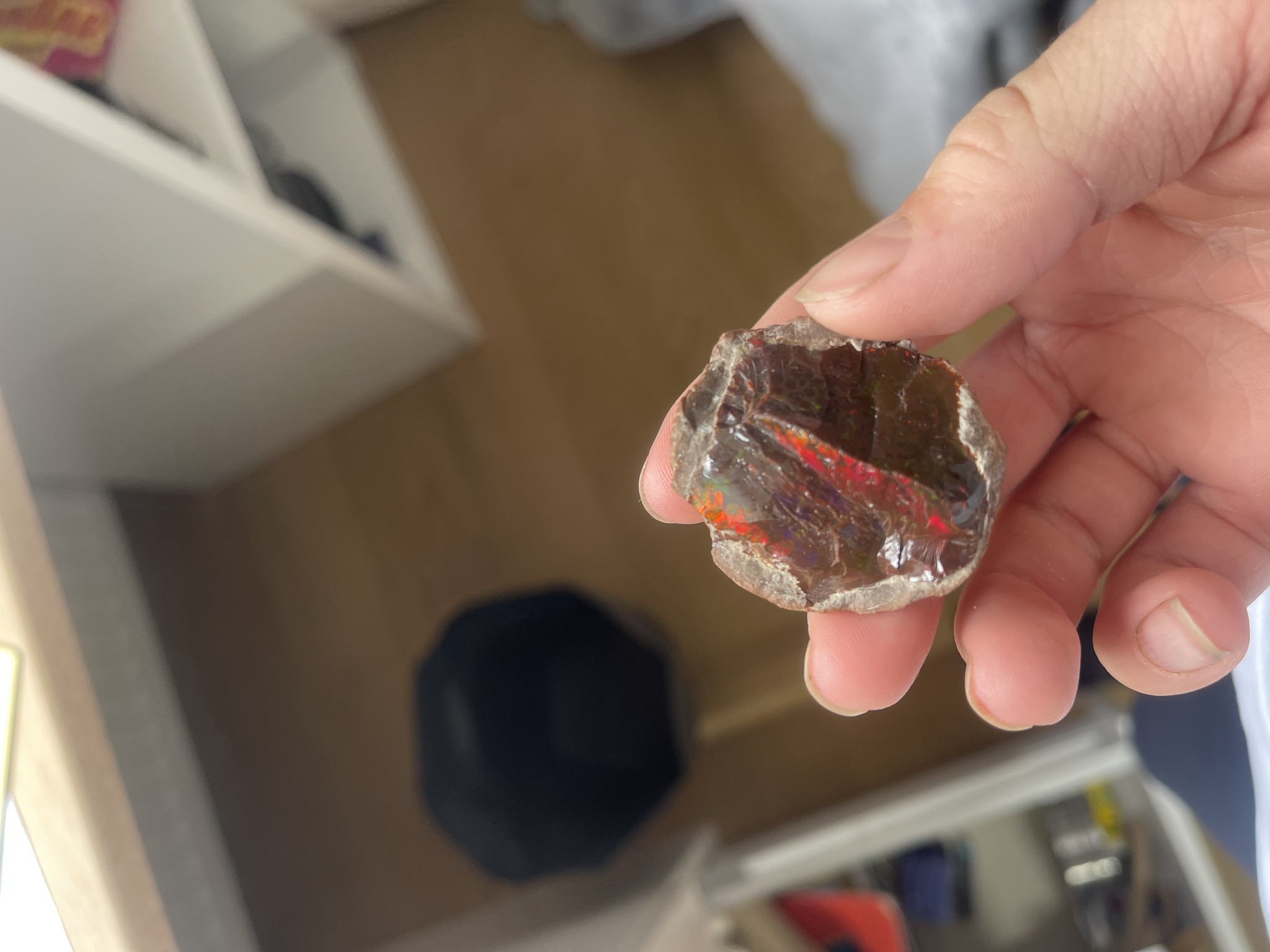
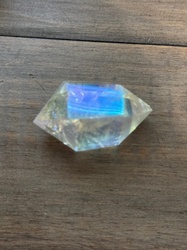
This physical item appears to be an unpolished or partially worked rough gemstone specimen, held in an open hand for scale. The specimen displays a rounded, somewhat irregular nodular form surrounded by an earthy, brownish matrix or host rock. The central fractured or exposed face reveals a vitreous to resinous luster with a dark base matrix displaying a vibrant play-of-color, characterized by flashes of bright red, orange, and hints of green and blue. There are no visible maker's marks, signatures, or stamps anywhere on the specimen; the identification rests entirely on the visual presence of optical play-of-color within a host matrix, which is consistent with precious opal or similar optical minerals. The condition appears to be natural and unrefined, showing rough edges, natural fractures, and an untreated surface consistent with raw mineral specimens. Regarding age or period, natural mineral specimens cannot be definitively dated from a photograph alone. The owner's unverified notes mention that the stone exhibits blue, red, purple, orange, green, and yellow hues, which corresponds with the observed chromatic flashes. Quality indicators such as the intensity of the color play suggest potential lapidary material, though internal stability and structural integrity remain unverified without physical testing.
AI Appraisal Report
Based on the provided photograph, I can observe a rough gemstone specimen displaying a dark matrix with notable play-of-color, including flashes of red, orange, green, and blue. Per user submission, the owner notes that the stone exhibits blue, red, purple, orange, green, and yellow hues. Based on visual characteristics alone, the specimen appears consistent with precious opal or a similar optical mineral within a host matrix. However, I can't verify from a photo the internal stability, exact composition, treatment status, or structural integrity of the material, all of which would need physical inspection to confirm. My appraisal estimate assumes that the owner's claims regarding the stone's optical properties and material type are correct. In current markets, rough gemstone specimens with vibrant play-of-color attract interest from lapidary enthusiasts and collectors, though values fluctuate heavily based on the stone's stability and potential yield if cut. If the specimen turns out to be a synthetic simulant, common common-opal without play-of-color, or a lower-grade matrix material rather than precious opal, the value would decrease significantly, likely ranging from $20 to $50 as a basic mineral specimen. To properly evaluate and establish a reliable market value, an in-person examination by a qualified gemologist, physical stability testing, and potentially scientific testing of the mineral matrix would be required.