AI estimate as of October 21, 2025 · verify with a professional before acting
AI-Generated · Verify before acting
Everything on this page is generated by AI for informational purposes only. AI can make mistakes — the AI may misidentify items or misattribute them (artist, maker, brand, designer, origin, era). This is not an official valuation and should not be used for insurance, sale, tax, estate, legal, or lending purposes — or any decision requiring a certified appraisal. It is not an authoritative claim about any person, brand, or rights holder — do not share or rely on it as a factual statement about a third party. Always consult qualified professionals before making financial decisions.
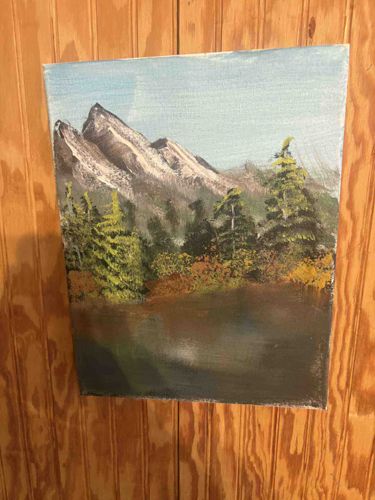
This item is an unframed landscape painting depicting a mountain range, evergreens, and a body of water, likely a lake or pond, in the foreground. The painting is executed on a canvas, though the exact dimensions are not provided, it appears to be of a moderate size, possibly around 16x20 or 18x24 inches based on the visual context. The technique suggests oil or acrylic paints, applied in a style reminiscent of 'wet-on-wet' methods, often associated with artists like Bob Ross. The color palette includes light blue for the sky, various shades of green and yellow-green for the pine trees, brown and ochre for the autumnal foliage, and dark grays and whites for the snowy or rocky peaks. The water in the foreground is rendered in dark greens and browns, with some lighter reflections suggesting a calm surface. Notable features include the textured application of paint, particularly on the mountain peaks and the foliage, where distinct brushstrokes create a sense of volume and detail. There are no visible artist's signatures, maker's marks, or specific manufacturing details apparent in the image. The immediate edges of the canvas appear slightly worn or unfinished, consistent with an unframed work. The painting's condition appears relatively good on the visible surface, with no obvious tears, significant scratches, or paint loss. The style suggests a mid-to-late 20th century or early 21st century piece, likely a decorative art item. The craftsmanship, while not hyper-realistic, demonstrates a capability to capture a serene natural scene with appealing visual depth.
AI Appraisal Report
I have examined the provided image of this unframed landscape painting depicting a mountain range, evergreens, and a body of water. Based on my visual assessment, the condition appears good, with no obvious tears, significant scratches, or paint loss. The technique, with its textured application and 'wet-on-wet' appearance, is consistent with oil or acrylic paints and is reminiscent of a decorative style popularized in the mid-to-late 20th and early 21st centuries.
Authenticity verification is highly limited by examining images alone. Without an in-person examination, it's impossible to confirm the exact medium, age, or artist. The lack of visible signatures or maker's marks is a significant factor in authenticating the piece. Physical inspection would allow me to assess the canvas quality, paint layers, and brushwork in detail, as well as search for any obscured marks. Provenance documentation, such as purchase receipts or exhibition history, would be crucial for attributing the work to a specific artist, if one exists.
Market conditions for unsigned, decorative landscape oil/acrylic paintings of this style are generally modest. While it is a pleasant and aesthetically appealing piece, the absence of an identifiable artist or unique artistic merit positions it within the general decorative art market. Comparable unsigned, moderately sized (e.g., 16x20 to 18x24 inches) landscape paintings in good condition typically fetch between $100 and $300 at auction or retail for decorative purposes. Demand for such pieces is steady but not exceptional, and rarity is not a factor here due to the commonality of the style. The primary factor impacting value is the lack of artist identification.
Considering these factors, and without any further information or physical inspection to suggest otherwise, my appraisal value reflects its status as a decorative art object rather than a fine art piece by a recognized artist.