AI estimate as of September 17, 2025 · verify with a professional before acting
AI-Generated · Verify before acting
Everything on this page is generated by AI for informational purposes only. AI can make mistakes — the AI may misidentify items or misattribute them (artist, maker, brand, designer, origin, era). This is not an official valuation and should not be used for insurance, sale, tax, estate, legal, or lending purposes — or any decision requiring a certified appraisal. It is not an authoritative claim about any person, brand, or rights holder — do not share or rely on it as a factual statement about a third party. Always consult qualified professionals before making financial decisions.
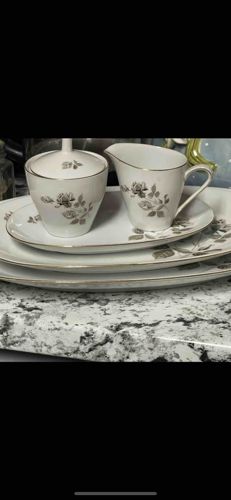
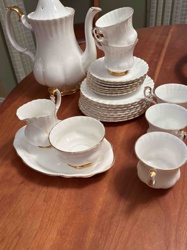
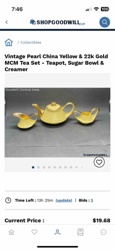
This item is a vintage creamer and covered sugar bowl set, crafted from white porcelain or fine china, featuring a delicate floral motif and elegant gold trim. The floral decoration consists of stylized roses and foliage, rendered in a muted gray or sepia tone, providing a subtle contrast against the pristine white background. Each piece, including the creamer, sugar bowl, and its lid, is edged with a thin, lustrous band of gold, which also appears as an accent on the handle of the creamer. The creamer has a gracefully curved spout and a C-shaped handle, suggesting a comfortable grip. The sugar bowl is ovoid with a fitted lid, topped by a small, integrated knob for easy removal. Both pieces rest on individual, coordinating saucers or small plates, which are also adorned with the same floral pattern and gold trim, indicating they are part of a larger dinnerware or tea set. The plates visible beneath the set are larger serving platters or dinner plates, showing the consistency of the pattern across the collection. The overall condition appears to be good, with no obvious chips, cracks, or significant wear visible from the provided image, though detailed inspection would be required to confirm this. The gold trim seems largely intact, suggesting careful use or storage. The style points to a mid-20th-century aesthetic, likely from the 1950s or 1960s, a period known for refined dinnerware with subtle adornments. The craftsmanship appears to be of good quality, with smooth finishes and a well-applied decorative pattern. No specific maker's marks are visible in the provided image.
AI Appraisal Report
Based on my visual examination of the provided image, this vintage creamer and lidded sugar set, along with its coordinating saucers and larger plates, appears to be in good overall condition. I observe no obvious chips, cracks, or significant wear to the porcelain or fine china, and the gold trim seems largely intact, suggesting careful handling. The delicate floral motif in a muted gray or sepia tone over a white background, combined with the elegant gold accents, strongly points to a mid-20th-century aesthetic, likely from the 1950s or 1960s. The craftsmanship, with smooth finishes and a well-applied decorative pattern, appears to be of good quality. The distinct C-shaped handle on the creamer and the ovoid shape of the sugar bowl with its integrated knob are consistent with dinnerware from that period. These pieces likely belong to a larger tea or dinnerware set.
Market conditions for vintage cream and sugar sets, particularly those without a prominent manufacturer's mark, are modest. Comparable sets from the mid-20th century, even in excellent condition, typically sell in the $30-$80 range. The inclusion of matching saucers and larger plates (though only partially visible) adds some value as it suggests a more complete collection. Demand for such items is consistent but not high, as they are often purchased for decorative purposes or by collectors filling out incomplete sets. Rarity is not a significant factor here; similar styles were mass-produced by various manufacturers during that era.
Factors impacting value include the condition (which appears very good), aesthetic appeal, and the consistency of the pattern across multiple pieces. Without visible maker's marks, it is challenging to attribute the set to a specific manufacturer, which limits its value to general vintage collectible appeal rather than brand-specific desirability. For full authentication and a more precise valuation, an in-person examination would be crucial to physically inspect for any subtle flaws, wear to the gilding not visible in images, and, most importantly, to locate and identify any hidden maker's marks, which are vital for determining origin and potential brand value. Provenance documentation, though unlikely for such an item, would also be beneficial.