AI estimate as of July 22, 2025 · verify with a professional before acting
AI-Generated · Verify before acting
Everything on this page is generated by AI for informational purposes only. AI can make mistakes — the AI may misidentify items or misattribute them (artist, maker, brand, designer, origin, era). This is not an official valuation and should not be used for insurance, sale, tax, estate, legal, or lending purposes — or any decision requiring a certified appraisal. It is not an authoritative claim about any person, brand, or rights holder — do not share or rely on it as a factual statement about a third party. Always consult qualified professionals before making financial decisions.
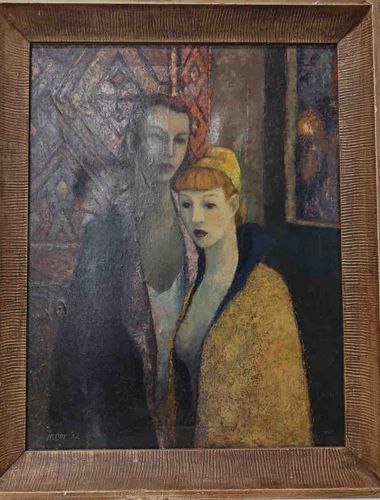
The item is a framed oil painting on canvas, depicting two female figures in an intimate, interior setting. The composition centers on a fair-skinned woman with red-blonde hair and bangs, wearing a yellow head covering and a vibrant yellow cloak with a dark blue lining. Her gaze is directed slightly downwards and to the left, with her lips parted, suggesting a moment of contemplation or speech. Beside and slightly behind her, an older-looking or more ethereal female figure is rendered in muted, desaturated tones, almost ghost-like, clad in a dark, possibly purple, garment with a light-colored undergarment visible. Her face is more angular and less defined than the foreground figure, with dark eyes and a faint red mark on her lips. Behind the figures, there's a textured background featuring what appears to be a patterned fabric or tapestry with geometric motifs in shades of brown and reddish-orange on the left, and a darker, less discernible background element to the right, possibly a window or another artwork, which shows a faint light source. The overall color palette is rich yet somewhat subdued, with strong textural brushwork, particularly evident in the garments and background. The painting is housed in a simple, textured light-brown wooden frame with a grooved or carved pattern around its inner edge, showing some signs of wear consistent with age. The signature 'McCoy' followed by '52' (likely indicating the year 1952) is visible in the lower left corner. The painting exhibits a somewhat melancholic or introspective mood, characteristic of mid-20th century portraiture, possibly with influences of Expressionism or Symbolism given the stylized nature of the figures. There are no immediately apparent signs of significant damage like tears or major paint loss, but the surface exhibits a soft sheen, possibly indicating an aged varnish layer. The craftsmanship appears to be professional, with skilled use of color and form to evoke an emotional response.
AI Appraisal Report
I have examined the image of this framed oil painting titled 'Two Figures (Double Portrait)'. The work, signed 'McCoy' and dated '52' (1952), exhibits strong textural brushwork and a rich, subdued color palette. The overall condition appears good, with no obvious major damage like tears or paint loss visible in the image. The soft sheen suggests an aged varnish layer. The craftsmanship is professional, evoking an introspective mood, possibly influenced by Expressionism or Symbolism. This period and style, particularly for unsigned or lesser-known artists, can see moderate demand. Comparable mid-century portraits by regional or unlisted artists typically range from $800 to $2,500, depending on quality, provenance, and subject matter appeal. The double portrait aspect and the emotional depth depicted enhance its appeal. However, without in-person examination, I cannot definitively verify the authenticity of the signature, the artist's full identity, or the exact medium and condition. A physical inspection would confirm brushwork, paint stability, and surface integrity. Full authentication would require provenance documentation, such as exhibition history or sales records, and potentially scientific analysis of the paint and canvas to confirm the age and materials. Given these limitations, the valuation is based primarily on visual aesthetics, apparent condition, and typical market performance for similar works of this era and quality.