AI estimate as of July 19, 2025 · verify with a professional before acting
AI-Generated · Verify before acting
Everything on this page is generated by AI for informational purposes only. AI can make mistakes — the AI may misidentify items or misattribute them (artist, maker, brand, designer, origin, era). This is not an official valuation and should not be used for insurance, sale, tax, estate, legal, or lending purposes — or any decision requiring a certified appraisal. It is not an authoritative claim about any person, brand, or rights holder — do not share or rely on it as a factual statement about a third party. Always consult qualified professionals before making financial decisions.
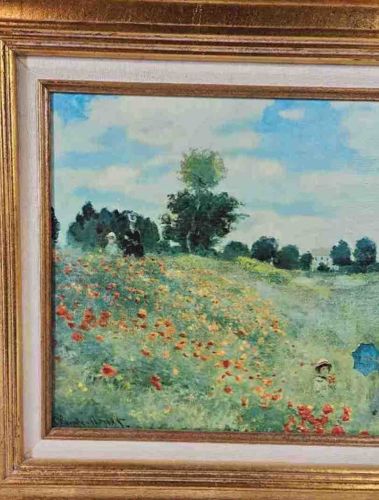
The item is a framed oil painting depicting a vibrant landscape scene, possibly a rendition of Claude Monet's 'Poppy Field at Argenteuil'. The artwork is characterized by its Impressionistic style, featuring loose brushstrokes and a bright, naturalistic color palette. The central motif is a large field of red and yellow poppies, rendered with visible texture that suggests impasto. In the background, there are lush green trees and shrubs, with a sliver of a building visible on a distant hill, hinting at a dwelling or village. The sky above is a clear, light blue with scattered white clouds. Figures are subtly incorporated into the landscape; one figure appears to be a woman in a white dress towards the left-center, partially obscured by the foliage, and another smaller figure, possibly a child with a hat, is visible on the right, accompanied by what appears to be a blue parasol. The painting is encased in a multi-layered gold frame, showing some signs of wear and minor scratching consistent with age, particularly on the outer edges and corners. The inner border of the frame is a lighter, possibly off-white, fabric or textured mat, providing a gentle transition to the artwork. The overall condition of the painting itself appears good, with no immediately visible cracks, flaking, or significant discoloration. The craftsmanship of the painting indicates an artist skilled in capturing light and atmosphere, characteristic of the late 19th or early 20th-century Impressionist movement. A faint, illegible signature may be visible in the bottom-left corner of the canvas, but it is not clear enough to identify the artist definitively from the provided image. The frame itself exhibits a decorative, possibly carved or molded, pattern, typical of frames from the period that would complement such artwork.
AI Appraisal Report
Upon visual examination of this Framed Impressionistic Landscape Painting (Poppy Field), I assess its condition as good. The painting itself shows no immediately visible damage like cracks or flaking. The colors appear vibrant, consistent with an Impressionistic style. The frame, while complementary, exhibits minor wear and scratching, typical for its age. My assessment of authenticity is limited by the fact that this is an image-based appraisal. The painting's style is clearly Impressionistic, reminiscent of Monet's 'Poppy Field at Argenteuil', but without a clear signature or provenance, it cannot be definitively attributed to a specific master. Market conditions for Impressionistic-style landscapes generally remain strong, with recognizable styles often commanding higher interest. Comparables would include 'school of' or 'after' pieces by well-known Impressionists. Demand for such a visually appealing piece is likely moderate, especially given its size and decorative appeal. Rarity is difficult to ascertain without knowing the artist; if it were an original by a listed artist, rarity would increase. Factors significantly impacting value are the lack of a clear artist's signature and provenance. This prevents it from being valued as an original by a master. The faint, illegible signature noted is insufficient for identification. For full authentication, an in-person examination is crucial to assess paint quality, canvas age, and potential underdrawings. Furthermore, provenance documentation (ownership history) and scientific testing (e.g., pigment analysis, carbon dating) would be essential to confirm authenticity, origin, and potential artist attribution.