AI estimate as of July 30, 2025 · verify with a professional before acting
AI-Generated · Verify before acting
Everything on this page is generated by AI for informational purposes only. AI can make mistakes — the AI may misidentify items or misattribute them (artist, maker, brand, designer, origin, era). This is not an official valuation and should not be used for insurance, sale, tax, estate, legal, or lending purposes — or any decision requiring a certified appraisal. It is not an authoritative claim about any person, brand, or rights holder — do not share or rely on it as a factual statement about a third party. Always consult qualified professionals before making financial decisions.
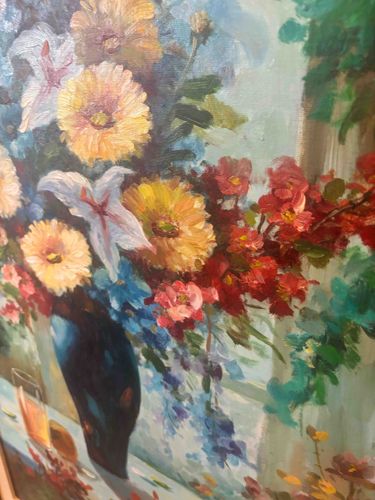
This item is an oil painting depicting a vibrant floral still life, likely set outdoors or near a window overlooking a garden scene. The prominent features include a dark blue or black vase filled with a generous arrangement of various flowers. The flowers showcase a rich palette, with dominant colors being bright yellow-orange dahlias or similar asters, white lilies with distinctive stamens, and clusters of small red-orange blossoms, possibly camellias or quince. There are also hints of blue and purple flowers cascading from the arrangement, possibly wisteria or delphinium. The brushstrokes are visibly thick and impasto, typical of oil painting, giving the flowers a textured, almost three-dimensional quality. The background appears to be a light blue sky or wall, with green foliage suggesting a garden or outdoor setting. To the left and slightly below the vase, a clear glass with an amber-colored liquid (presumably a drink) and what appears to be a plate or serving dish can be observed on a table surface, adding to the still life composition. The overall style suggests an impressionistic or post-impressionistic influence, with a focus on color, light, and texture over precise detail. No specific signatures or maker's marks are visible in the provided image. The condition appears good from the limited view, with no obvious signs of significant damage, tears, or repairs, though a full assessment would require viewing the entire piece and its frame. The colors are still vivid and well-preserved. Given the style and visible characteristics, the painting likely dates from the mid-20th century to contemporary times. The craftsmanship indicates a skilled hand, particularly in the rendering of the diverse floral forms and the interplay of colors and light.
AI Appraisal Report
Upon visual examination of this oil painting, titled 'Floral Still Life with Vase and Drink,' I note its vibrant depiction and skilled execution. The impasto brushwork, particularly evident in the floral arrangement, creates a pleasing textural quality and suggests a post-impressionistic influence. The colors remain vivid, indicating good preservation. Based on the provided image, the painting appears to be in good condition, with no visible tears, significant paint loss, or repairs. However, a definitive condition assessment would require in-person inspection to evaluate the canvas tension, stretcher integrity, and potential hidden damages or repairs under different lighting conditions.
Authenticity verification from images alone has significant limitations. While the artistic style suggests a skilled hand, I cannot confirm authorship or a specific period without seeing the reverse of the canvas for signatures, labels, or inscriptions. Provenance documentation, such as exhibition history, sales records, or artist's statements, would be crucial for establishing authenticity. Furthermore, scientific analysis, including pigment analysis or carbon dating of the canvas, could provide more precise dating information.
Regarding market conditions, floral still lifes remain a consistently popular genre among collectors. The vibrant colors and impressionistic style often attract buyers seeking decorative art. Comparable works by unestablished or emerging artists of similar skill level typically retail in the lower to mid-hundreds. Paintings by listed artists with established provenance would command significantly higher values. The demand for well-executed decorative art is steady, but without artist attribution, rarity is difficult to ascertain.
The most significant factor impacting value is the lack of a visible signature or provenance. If this piece were attributed to a recognized artist, its value would escalate dramatically. Until then, it is valued primarily as a decorative art piece based on its aesthetic appeal and technical execution.