AI Appraisal Estimate

AI-generated estimates · not official valuations

From the user

What was submitted

Photo and notes provided by the user — not generated by AI

Submitted item photo
Submitted photo · June 13, 2026

User's notes

No additional notes provided.

AI analysis below

AI appraisal

AI analysis & estimate

AI-Generated · Verify before acting

Everything below is generated by AI for informational purposes only. AI can make mistakes — the AI may misidentify items or misattribute them (artist, maker, brand, designer, origin, era). This is not an official valuation and should not be used for insurance, sale, tax, estate, legal, or lending purposes — or any decision requiring a certified appraisal. It is not an authoritative claim about any person, brand, or rights holder — do not share or rely on it as a factual statement about a third party. Always consult qualified professionals before making financial decisions.

Read the full disclaimer

AI Identification

·Not independently authenticated·Verify before acting

Byzantine-Style Madonna and Child Religious Icon

Religious Art & Icons

AI Estimated Value

·Not an official valuation·Verify before acting

$400 - $650

As of June 13, 2026

AI Item Analysis

·AI can make mistakes·Verify before acting
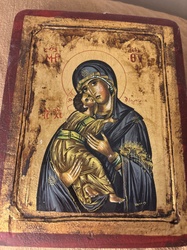
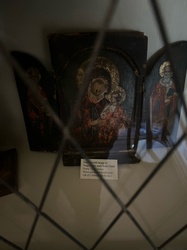
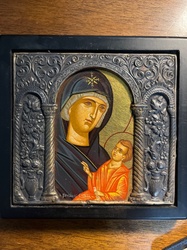
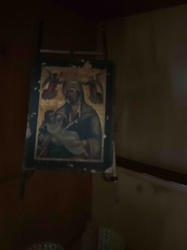
This item is a framed religious icon depicting the 'Santa Maria' (Madonna and Child) in a classic Byzantine or early Italian devotional style. The central figure features the Virgin Mary seated on an architectural throne, draped in a traditional deep blue mantle with gold trim, cradling the Christ child who is depicted with a cruciform halo. The background is characterized by a textured, gilded aesthetic with a mottled bronze and gold patina, featuring the Latin inscription 'SANTA MARIA' across the upper field. The figures are rendered with the stylized, elongated features and solemn expressions typical of Eastern Orthodox or Medieval Western iconography. The piece is housed in a square, substantial wooden cove-molded frame with a natural brown finish and visible wood grain. The icon appears to be executed on a wooden panel or a heavy board, possibly using encaustic, tempera, or an oil-based medium with metallic leaf highlights. Regarding condition, there is evident craquelure throughout the painted surface and significant distressing to the background gilding, which suggests age or intentional antiquing. The lower portion of the image shows some fading and darkening of the pigments. The frame exhibits minor surface scuffs and dust accumulation but remains structurally sound. The overall craftsmanship reflects a high-quality reproduction or a late 19th to mid-20th-century devotional object intended to mimic the appearance of ancient sacred art.
AI Appraisal Report

·AI can make mistakes·Verify before acting
I have conducted a visual examination of the 'Santa Maria' Madonna and Child icon. The piece displays a sophisticated mastery of Byzantine stylistic conventions, including the archaizing seated pose and stylized cruciform halo. While the craquelure and mottled gilt suggest antiquity, the specific uniformity of the distressing and the frame’s construction indicate this is most likely a high-quality mid-20th-century reproduction or a 'faux-antique' devotional piece common in the Mediterranean market. The condition is fair to good. While the surface darkening and pigment fading appear to be intentional aging techniques, there is actual environmental wear on the wooden frame. In the current market, mid-century religious icons hold steady value as decorative objects and liturgical items, though they lack the high premium associated with 15th-18th century originals. Comparables for professionally distressed 20th-century panel icons typically achieve mid-hundred dollar ranges at specialized auctions. Several limitations exist in this remote appraisal. From images alone, I cannot confirm if the substrate is a solid hardwood panel or a composite board, nor can I verify the binding medium (e.g., egg tempera versus modern acrylic-based glazes). To finalize authentication and potentially increase the valuation, an in-person inspection is required to check for 'hot needle' tests on the gilding, microscopic analysis of the paint layers for modern pigments, and an examination of the board's reverse for carpenter marks or historical provenance labels. Without documented lineage or scientific proof of age, the value remains based on its decorative and devotional utility rather than historical rarity.

Get your items appraised

Instant estimates of your treasures with AI-powered appraisals

Browse More Appraisals