Eastern Orthodox Icon of the Virgin Mary and Child
Religious Art & Icons

Eastern Orthodox Icon of the Virgin Mary and Child

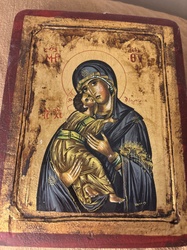
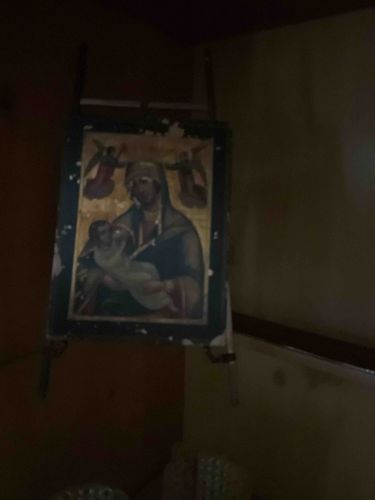
This item is a religious icon depicting the Virgin Mary (Theotokos) holding the Christ Child, flanked by two celestial figures, likely archangels, in the upper corners. The artwork is executed in a traditional Byzantine or Eastern Orthodox style, typically characterized by egg tempera on a wooden panel. The central figures are presented in a sacred, formalized pose against a once-gilded background that has significantly tarnished and worn. The Virgin is draped in a dark navy blue or black maphorion, while the Christ Child appears in lighter garments. The physical condition is poor, showing extensive surface loss, flaking paint, and significant wood exposure around the borders and corners. There are visible abrasions and missing sections of the pictorial layer, indicating age and lack of climate-controlled preservation. The icon is currently displayed on a metal or wooden easel stand. While no specific maker's marks are visible due to the environmental lighting and degradation, the iconography suggests a late 19th to early 20th-century origins, possibly from a Slavic or Greek workshop. The overall craftsmanship reflects traditional hagiography techniques, though the substantial structural and surface damage would require professional restoration to stabilize.
Estimated Value

$400 - $600

Basic Information

Category

Religious Art & Icons

Appraised On

March 2, 2026

Estimated Value

$400 - $600

Item Description

This item is a religious icon depicting the Virgin Mary (Theotokos) holding the Christ Child, flanked by two celestial figures, likely archangels, in the upper corners. The artwork is executed in a traditional Byzantine or Eastern Orthodox style, typically characterized by egg tempera on a wooden panel. The central figures are presented in a sacred, formalized pose against a once-gilded background that has significantly tarnished and worn. The Virgin is draped in a dark navy blue or black maphorion, while the Christ Child appears in lighter garments. The physical condition is poor, showing extensive surface loss, flaking paint, and significant wood exposure around the borders and corners. There are visible abrasions and missing sections of the pictorial layer, indicating age and lack of climate-controlled preservation. The icon is currently displayed on a metal or wooden easel stand. While no specific maker's marks are visible due to the environmental lighting and degradation, the iconography suggests a late 19th to early 20th-century origins, possibly from a Slavic or Greek workshop. The overall craftsmanship reflects traditional hagiography techniques, though the substantial structural and surface damage would require professional restoration to stabilize.

Get Your Items Appraised

Instant estimates of your treasures with AI-powered instant appraisals

Browse More Appraisals