These notes were written by the person who submitted this item. Appraiser.AI has not verified them, and the AI's identification and estimate may rely on them.
AI Estimated Value
Not an official valuation
€450-750
AI estimate as of August 16, 2025 · verify with a professional before acting
AI-Generated · Verify before acting
Everything on this page is generated by AI for informational purposes only. AI can make mistakes — the AI may misidentify items or misattribute them (artist, maker, brand, designer, origin, era). This is not an official valuation and should not be used for insurance, sale, tax, estate, legal, or lending purposes — or any decision requiring a certified appraisal. It is not an authoritative claim about any person, brand, or rights holder — do not share or rely on it as a factual statement about a third party. Always consult qualified professionals before making financial decisions.
This analysis also relies on unverified notes provided by the user, which may be incomplete or inaccurate and could affect the result.
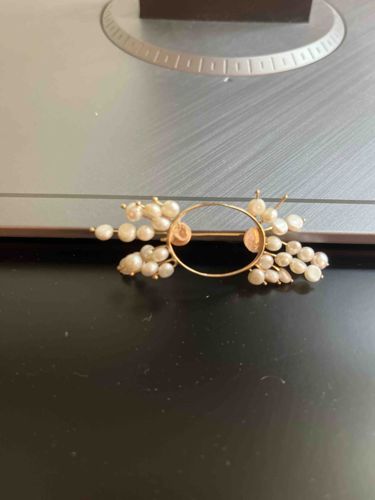
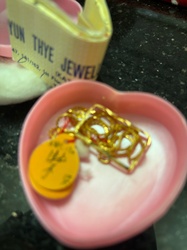
This appears to be a vintage or antique brooch, potentially converted to a pendant or designed with loops for versatile wear, based on the context provided. The primary material is a warm-toned yellow metal, likely gold or a gold-plated alloy, evident from the main body and the slender wire-like constructions. It features a central open oval or elliptical frame, crafted from a smooth, polished metal band. Extending from this central oval are numerous clusters of small, irregularly shaped pearls, characteristic of freshwater or baroque pearls, ranging in color from creamy white to very light beige, with a natural luster. These pearls are individually attached with fine wires, creating a delicate, organic, and somewhat 'spray' or 'grape' cluster effect around the central motif. Two distinct circular elements, possibly decorative bezels or settings, are visible within the central oval, their exact material or purpose unclear from the image but suggesting an intended focal point or perhaps former stone settings. The overall construction displays fine craftsmanship, with particular attention to how the pearls are secured to create a sense of volume and movement. Given the style, it likely dates from the late 19th to early 20th century, possibly Edwardian or Art Nouveau, an era known for its use of naturalistic motifs and pearls. The condition appears good for its age, with no obvious signs of significant damage or missing pearls, though a slight patina commensurate with age may be present on the metal.
AI Appraisal Report
Upon examining the provided image and description of this vintage pearl and gold-tone brooch/pendant, my assessment is as follows. The piece presents in remarkably good condition for its presumed age, showing a natural patina on the metal consistent with an early 20th-century origin, likely Edwardian or Art Nouveau. The numerous irregularly shaped pearls, characteristic of freshwater or baroque varieties, appear securely attached, forming attractive clusters around a central open oval. The 'spray' effect of the pearls suggests fine craftsmanship and an organic aesthetic. Authenticity, based solely on visual examination, appears high for an item of this vintage style; the construction details and pearl settings align with period techniques. However, without physical examination, I cannot definitively confirm whether the yellow metal is solid gold, gold-filled, or gold-plated, which significantly impacts value. The two circular elements within the central oval are intriguing; an in-person inspection would clarify if these are decorative or indicate former settings for additional stones.
Market conditions for vintage pearl jewelry remain steady, with a consistent demand for unique, well-preserved pieces. This item's dual functionality as a brooch and pendant enhances its desirability. Comparing it to similar pieces, particularly those from the specified eras, suggests a mid-range value. Rarity is moderate; while vintage pearl jewelry is not uncommon, pieces with this specific design and apparent condition are less frequently encountered.
Factors significantly impacting value include the actual metal content (solid gold would command a much higher price), the quality and origin of the pearls (natural vs. cultured, and their specific type), and most importantly, an in-person assessment of any underlying damage or repairs not visible in the image. For full authentication and a more precise valuation, a physical examination by a professional gemologist is crucial to determine metal purity (e.g., acid testing or XRF analysis), pearl characteristics, and to inspect the overall structural integrity. Provenance documentation, if available, would also add considerable value and confirmation of its history.