These notes were written by the person who submitted this item. Appraiser.AI has not verified them, and the AI's identification and estimate may rely on them.
AI Estimated Value
Not an official valuation
$40,000 - $60,000
AI estimate as of August 26, 2025 · verify with a professional before acting
AI-Generated · Verify before acting
Everything on this page is generated by AI for informational purposes only. AI can make mistakes — the AI may misidentify items or misattribute them (artist, maker, brand, designer, origin, era). This is not an official valuation and should not be used for insurance, sale, tax, estate, legal, or lending purposes — or any decision requiring a certified appraisal. It is not an authoritative claim about any person, brand, or rights holder — do not share or rely on it as a factual statement about a third party. Always consult qualified professionals before making financial decisions.
This analysis also relies on unverified notes provided by the user, which may be incomplete or inaccurate and could affect the result.
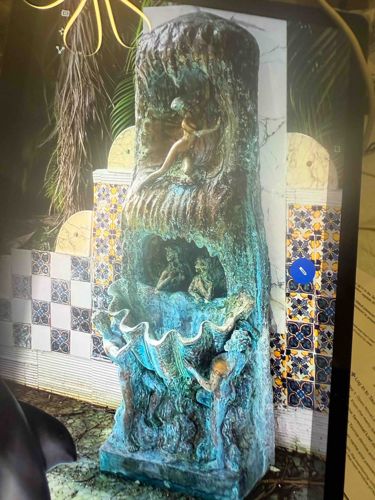
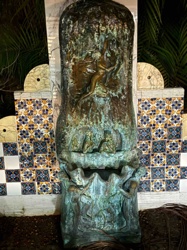
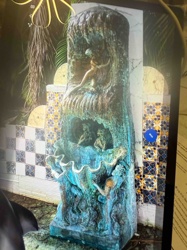
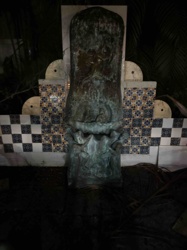
This is a large, ornate bronze fountain designed for outdoor use, likely in a garden or courtyard setting. The primary material appears to be bronze, evidenced by the rich, mottled green and blue-green patina (verdigris) that indicates prolonged exposure to the elements. The fountain takes on an organic, almost architectural form, resembling a natural grotto or rock formation. It features multiple figurative elements: at the top level, a reclining female figure, possibly a nymph or mermaid, appears to be emerging from or resting within a cascade-like recess. Below her, within another cavernous opening, are two smaller, possibly cherubic or putti-like figures. The base of the fountain is dominated by a large, intricately sculpted clam or scallop shell, which serves as the primary basin for the circulating water. Surrounding and supporting this shell are additional smaller figures or creatures, possibly tritons or similar sea mythical beings, integrated dynamically into the flowing, wave-like forms of the bronzework. The overall construction exhibits significant craftsmanship, with detailed sculpting evident in the figures, the texture of the 'rock' formations, and the ribbed shell. The heavy patina suggests considerable age or a deliberate aging process. There are no immediate visible signs of major damage or repairs, but the extensive patina obscures finer details and would require closer inspection. The style is classical or neoclassical, incorporating mythological figures, common in garden sculptures from the 19th or early 20th century, though contemporary reproductions also adopt this aesthetic. The quality of the bronze casting and the intricate details suggest a high-end, custom-made piece rather than mass production.
AI Appraisal Report
Based on my visual examination of the images provided, this Bronze Figurative Grotto Fountain with Clam Shell Basin is a significant and masterfully executed piece. My assessment is based on the quality of the casting, the intricate mythological subject matter, and its substantial size. The fountain depicts a classical grotto scene with a reclining nymph, putti, and triton-like figures supporting a large clam shell basin. The extensive and well-developed verdigris patina is consistent with significant age, likely dating it to the late 19th or early 20th century. However, it could also be a high-quality 20th-century reproduction with an expertly applied patina. The overall condition appears to be very good, with no obvious signs of significant damage, cracks, or crude repairs, although the deep patina may obscure such issues. The market for large-scale, high-quality bronze garden statuary remains robust, particularly for pieces that evoke a Gilded Age or classical European aesthetic. Similar large, multi-figure bronze fountains of this period and quality often sell for substantial sums at auction. The primary factor influencing value here is authenticity and artist attribution. Without a physical inspection, it is impossible to definitively authenticate the piece or rule out a later reproduction. A full appraisal would require an in-person examination to search for a foundry mark or artist's signature, an assessment of casting techniques, and ideally, provenance documentation tracing its ownership history. X-ray fluorescence (XRF) analysis could also help determine the alloy's composition to date it more accurately.