These notes were written by the person who submitted this item. Appraiser.AI has not verified them, and the AI's identification and estimate may rely on them.
AI Estimated Value
Not an official valuation
$12,000 - $18,000
AI estimate as of August 26, 2025 · verify with a professional before acting
AI-Generated · Verify before acting
Everything on this page is generated by AI for informational purposes only. AI can make mistakes — the AI may misidentify items or misattribute them (artist, maker, brand, designer, origin, era). This is not an official valuation and should not be used for insurance, sale, tax, estate, legal, or lending purposes — or any decision requiring a certified appraisal. It is not an authoritative claim about any person, brand, or rights holder — do not share or rely on it as a factual statement about a third party. Always consult qualified professionals before making financial decisions.
This analysis also relies on unverified notes provided by the user, which may be incomplete or inaccurate and could affect the result.
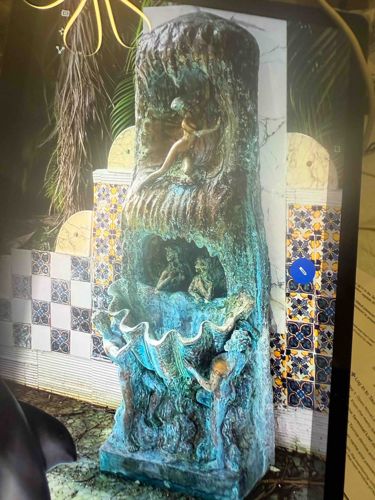
This appears to be a large, free-standing bronze fountain, designed to evoke a grotto or natural aquatic scene. The primary material is bronze, as indicated by the 'brinze fountain' context and the visible green-blue patina, characteristic of oxidized copper alloys. The fountain stands upright, likely several feet in height, with a substantial base for stability. Its construction is intricate, featuring multiple tiers and sculpted figures. The overall form simulates natural rock formations or cascading water, with a prominent shell-shaped basin at the bottom, resembling a large clam or scallop.
Observable features include several sculpted figures integrated into the design: a partially nude female figure (possibly a nymph or mermaid) is visible in the upper section, reclining amidst what resembles carved waves or a cave opening. Below her, within a simulated grotto, two smaller, possibly cherubic or putti-like figures are seated. At the base of the fountain, near the shell basin, one can discern what appear to be sculpted sea creatures or additional mythological figures, such as a hippocampus or merfolk, supporting the structure or emerging from it. The craftsmanship displays a high level of detail in the sculpting of the figures and the textural rendering of the 'rock' and 'water' elements.
The condition exhibits significant, widespread verdigris patina, which is desirable for aged bronze pieces and indicates natural weathering. There are no obvious signs of severe damage, cracks, or repairs visible in the provided images, though a full inspection would be required to confirm. The patina's variation in color, from darker bronzes to vibrant teal and blue-green hues, suggests prolonged outdoor exposure and adds to its aesthetic appeal and perceived age. Based on the neoclassical or romantic style of the figures and the detailed construction, it likely dates from the late 19th to mid-20th century, or is a reproduction in that style. The quality of casting and sculptural work appears high, indicative of a skilled artisan.
AI Appraisal Report
Upon examination of the provided images, I have assessed this Bronze Grotto Fountain with Figurines. The piece is a substantial outdoor sculpture, likely cast in bronze, exhibiting a significant and aesthetically pleasing verdigris patina consistent with prolonged outdoor exposure. The design, featuring a reclining nymph, putti, and mythological sea creatures in a grotto setting, is characteristic of the late 19th or early 20th-century neoclassical or romantic styles. The quality of the casting and the sculptural detail appear to be of high caliber.
Based on visual inspection alone, the fountain appears to be in good antique condition with no immediately visible cracks, fractures, or modern repairs. The widespread patina is a primary value-driver, suggesting age and authenticity. Market comparables for large-scale, well-cast bronze fountains of this period and style often fetch prices well into the five-figure range, especially when attributed to a known foundry or artist. The demand for such grand, decorative garden elements remains strong among collectors and landscape designers.
However, this appraisal is limited by the inability to conduct a physical inspection. For a definitive valuation and authentication, I would need to examine the piece in person to search for a foundry mark or artist's signature, assess the structural integrity, and check for hidden repairs. Further research into provenance and, if necessary, a metallurgical analysis (X-ray fluorescence) would confirm the bronze alloy composition and age, distinguishing it from a later reproduction, which would significantly alter its value.