These notes were written by the person who submitted this item. Appraiser.AI has not verified them, and the AI's identification and estimate may rely on them.
AI Estimated Value
Not an official valuation
$10,000 - $15,000
AI estimate as of August 19, 2025 · verify with a professional before acting
AI-Generated · Verify before acting
Everything on this page is generated by AI for informational purposes only. AI can make mistakes — the AI may misidentify items or misattribute them (artist, maker, brand, designer, origin, era). This is not an official valuation and should not be used for insurance, sale, tax, estate, legal, or lending purposes — or any decision requiring a certified appraisal. It is not an authoritative claim about any person, brand, or rights holder — do not share or rely on it as a factual statement about a third party. Always consult qualified professionals before making financial decisions.
This analysis also relies on unverified notes provided by the user, which may be incomplete or inaccurate and could affect the result.
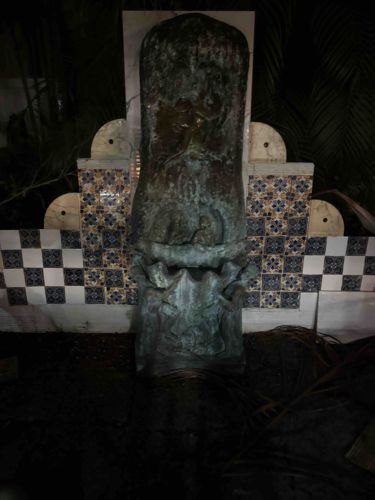
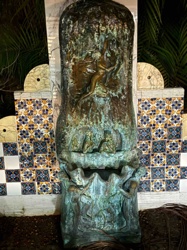
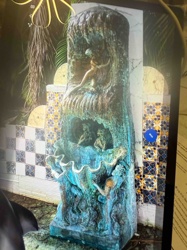
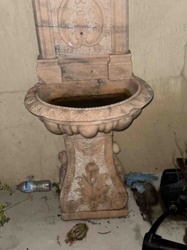
This appears to be an antique outdoor fountain, likely made of patinated bronze or a similar bronze-toned metal, given its dark, greenish-brown coloration indicative of oxidation. The central element of the fountain is a tall, slender, and somewhat irregularly shaped sculptural piece that serves as the water spout. At the top of this central piece, there's a relief-sculpted face or mask, possibly depicting a weathered human or mythological figure with prominent facial features and a flowing beard, from which water would likely issue. Below this face, the main column widens into a basin or reservoir, adorned with what appear to be figurative elements, possibly mermaids, putti, or other aquatic-themed figures, serving as supports or decorative motifs around a scallop-shaped or fluted shell-like basin. These figures appear somewhat obscured by the dark lighting and the patina. The fountain is set against a wall or backdrop largely composed of white and blue ceramic tiles, arranged in a checkerboard pattern at the bottom, and more decorative, possibly floral or geometric patterns, in the sections above. Some of these tiles also show wear or discoloration. The back wall features architectural detailing, including arched or semi-circular cutouts or applied elements made of what might be light-colored stone or concrete, providing further structure to the fountain's setting. The area directly in front of the fountain is dark, suggesting a pond or water collection basin that is not clearly visible in the low light. The aged appearance, intricate detailing, and classical or allegorical motifs suggest an antique or vintage period, possibly late 19th to early 20th century. The significant patina on the metal indicates long-term exposure to the elements, which is typical for outdoor bronze pieces and does not necessarily denote damage but rather age and character. The overall craftsmanship suggests a high-quality, custom-made, or artist-designed piece rather than a mass-produced item.
AI Appraisal Report
Based on my examination of the image of this Patinated Bronze Figurative Fountain with Tiled Backdrop, I assess its overall condition as good, commensurate with age and its intended outdoor use. The significant, even patina on the bronze is a desirable characteristic, indicating authenticity and long-term exposure, rather than damage. The intricate sculptural details, including the central mask and surrounding figurative elements, appear largely intact, though obscured by lighting and patina. The tiled backdrop shows expected wear and some discoloration, but its patterned design enhances the fountain's aesthetic.
From the visual evidence, this appears to be an authentic antique piece, likely late 19th to early 20th century, as suggested by its classical form and detailed craftsmanship. It falls into the category of architectural features and outdoor decor. Market conditions for substantial, well-preserved antique garden ornaments of this quality are stable, with demand driven by collectors of antique statuary and landscape designers seeking unique focal points. Its scale and artistic merit contribute to its rarity.
Factors significantly impacting its value include its age, perceived material (bronze), intricate sculptural details, and the overall completeness of the installation. The 'antique fountain' information provided by the owner aligns with my visual assessment.
However, it is crucial to note the limitations of an appraisal based solely on images. Full authentication would require a physical inspection to verify the material (e.g., solid bronze vs. cast iron or spelter), assess structural integrity, identify foundry marks or artist signatures, and confirm restoration history. Provenance documentation (e.g., original purchase receipts, historical photos) would further solidify its authenticity and potentially its historical significance. Scientific testing, such as elemental analysis, could definitively confirm material composition and age.