AI estimate as of August 17, 2025 · verify with a professional before acting
AI-Generated · Verify before acting
Everything on this page is generated by AI for informational purposes only. AI can make mistakes — the AI may misidentify items or misattribute them (artist, maker, brand, designer, origin, era). This is not an official valuation and should not be used for insurance, sale, tax, estate, legal, or lending purposes — or any decision requiring a certified appraisal. It is not an authoritative claim about any person, brand, or rights holder — do not share or rely on it as a factual statement about a third party. Always consult qualified professionals before making financial decisions.
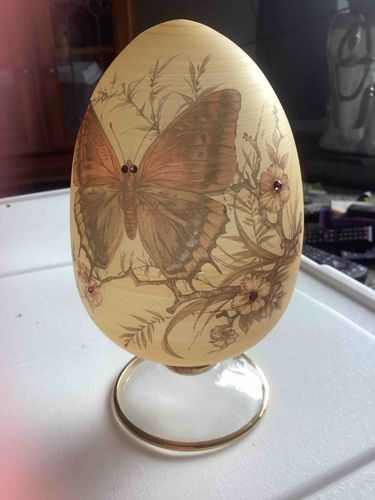
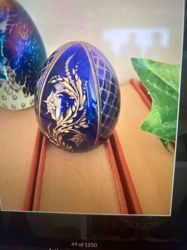
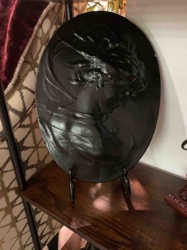
This exquisite decorative item is an egg-shaped ornament, likely crafted from polished natural wood or a high-quality resin, presenting a smooth, pale cream to light yellow surface. The primary decorative element is a meticulously rendered image of a large butterfly with detailed wings in shades of brown and orange, prominently positioned on the front surface. The butterfly's eyes appear to be small, dark, possibly bead-like or painted accents. Surrounding the butterfly are delicate botanical motifs, including branches, leaves, and various flowers, all outlined in a warm brown or sepia tone, suggesting a pyrography (wood burning) technique or highly detailed printing. Some of the flowers are embellished with small, glistening inlays, possibly rhinestones or polished stones, adding a subtle sparkle. The ornament is mounted on a clear, perhaps glass or acrylic, pedestal base with a trumpet-like form, providing stability and elevation. A thin, golden-colored ring, likely brass or a gilded metal, encircles the bottom edge of the glass stand, adding a touch of elegance. The overall condition appears excellent, with no visible signs of significant wear, chips, or damage. The colors of the artwork are vibrant and well-preserved. There are no discernible maker's marks or signatures visible in the provided image. The style evokes a classic, possibly vintage, aesthetic, reminiscent of early to mid-20th century decorative arts, though it could also be a contemporary piece designed to emulate that era. The craftsmanship suggests a high level of detail and care in its creation, indicative of a quality decorative item.
AI Appraisal Report
Upon examining this Decorated Egg Ornament with Butterfly and Floral Motif on Pedestal Stand, my initial assessment, based solely on the provided image, indicates a well-preserved decorative item. The apparent excellent condition, with no visible chips, cracks, or significant wear, suggests careful handling. The vibrancy of the artwork and the intact nature of the inlays further support this.
Authenticity is difficult to ascertain definitively from an image alone. While the description mentions pyrography or detailed printing, and the style evokes a classic aesthetic, without in-hand inspection, I cannot confirm the specific artistic technique (e.g., hand-painted vs. decal), the material composition (wood, resin, or other), or the true age. The quality of craftsmanship is evident in the detailed motif and smooth finish.
The market for decorative art objects like this is generally stable, though demand can fluctuate based on aesthetic trends. Comparable items, ranging from vintage decorative eggs to finely crafted contemporary pieces, can fetch prices from modest to significant, influenced heavily by artist attribution (if any), provenance, and material value. Given the lack of discernible maker's marks or signatures, and assuming it's unauthenticated as a specific antique, its value leans towards that of a high-quality decorative accent rather than a fine collectible.
The primary factors impacting value here are its pleasing aesthetic, apparent good condition, and the perceived quality of artistry. Rarity is not a significant factor without further information on its origin or limited production. The subtle sparkle from the inlays adds a nice touch, enhancing its visual appeal.
For full authentication and a more precise valuation, I would require a physical examination to determine the exact material composition, confirm the decorative technique (e.g., true pyrography, hand-painting, or high-quality transfer), assess the quality and origin of the inlays, and search for any hidden maker's marks. Scientific testing could verify material age and composition, and provenance documentation (e.g., original purchase receipts, designer information) would significantly impact its collectibility and value.