AI estimate as of November 1, 2025 · verify with a professional before acting
AI-Generated · Verify before acting
Everything on this page is generated by AI for informational purposes only. AI can make mistakes — the AI may misidentify items or misattribute them (artist, maker, brand, designer, origin, era). This is not an official valuation and should not be used for insurance, sale, tax, estate, legal, or lending purposes — or any decision requiring a certified appraisal. It is not an authoritative claim about any person, brand, or rights holder — do not share or rely on it as a factual statement about a third party. Always consult qualified professionals before making financial decisions.
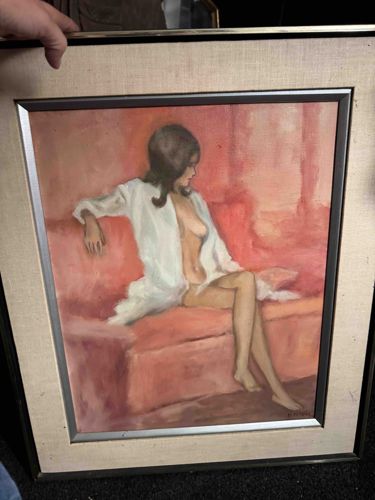
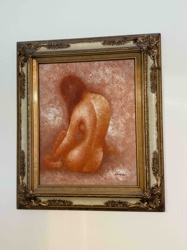
This item is an oil painting depicting a seated woman. The woman, with dark brown hair styled around her shoulders, is rendered from the waist up, facing to the right and looking slightly downwards. She is clad in a loose, open white robe, revealing her bare upper torso. Her left arm rests casually on what appears to be a reddish-pink or coral-colored cushion or armrest, while her right arm is less visible, possibly placed behind her or along her lap. The background consists of a soft, blended gradient of similar reddish-pink and coral tones, suggesting an indoor setting, perhaps a couch or chaise lounge. The brushstrokes appear relatively soft and fluid, indicating an impressionistic or loose figurative style. The overall color palette is warm, dominated by various shades of pink, red, and muted orange, contrasted with the white of the robe and the skin tones. The painting is housed within a multi-layered frame. The outermost frame is made of a light-colored wood, possibly oak or a natural wood finish, with a slightly textured, possibly linen or burlap-like, inner border. This is followed by a thin, metallic silver-colored fillet, which directly borders the painting. The visible condition suggests some potential wear commensurate with age, particularly on the frame, where slight scuffs or discoloration might be present, though not clearly visible in the provided image. The painting itself appears to be in reasonably good condition with no obvious tears, significant cracking (craquelure), or paint loss visible from the distance of the photograph. The style suggests a mid-20th century to late 20th century aesthetic, possibly from the 1960s or 1970s, given the depiction of the figure and the prevalent color schemes of that era. There are no clear signatures or maker's marks visible in the image to identify the artist or specific manufacturing details.
AI Appraisal Report
Based on my visual examination of this oil painting depicting a seated woman in a white robe, I assess its authenticity and condition. The painting technique, characterized by soft, fluid brushstrokes and a warm color palette of pink, red, and muted orange, suggests a mid-to-late 20th-century aesthetic, likely 1960s or 1970s. The artwork appears to be in reasonably good condition, with no visible tears, significant craquelure, or paint loss from the photograph. The frame, a multi-layered design with a light-colored wood outer and a metallic silver fillet, shows some minor wear commensurate with age, though not clearly visible in detail.
Market conditions for unsigned figural art from this period are generally moderate. While the piece is aesthetically pleasing, the absence of a signature or artist identification significantly limits its value. Comparables for decorative, unsigned oil paintings of this style typically fall within the low to mid-hundreds range. Demand for such pieces is steady but not high, primarily from individuals looking for appealing decorative art rather than investment-grade works. Rarity is not a factor here due to the lack of artist attribution.
Factors significantly impacting value include the lack of a visible signature and provenance. Without an artist's name, it's impossible to link it to a recognized oeuvre or market.
It is crucial to note that this assessment is based solely on visual examination of the provided image. For a definitive authentication, an in-person examination is essential to inspect the artwork's surface, canvas, and stretcher, and to search for obscured signatures or marks. Provenance documentation, such as purchase receipts or exhibition history, if available, would be vital. Scientific testing, like pigment analysis or UV light examination, could confirm the age and condition more precisely, and potentially reveal underlying details not visible to the naked eye.