AI estimate as of November 6, 2025 · verify with a professional before acting
AI-Generated · Verify before acting
Everything on this page is generated by AI for informational purposes only. AI can make mistakes — the AI may misidentify items or misattribute them (artist, maker, brand, designer, origin, era). This is not an official valuation and should not be used for insurance, sale, tax, estate, legal, or lending purposes — or any decision requiring a certified appraisal. It is not an authoritative claim about any person, brand, or rights holder — do not share or rely on it as a factual statement about a third party. Always consult qualified professionals before making financial decisions.
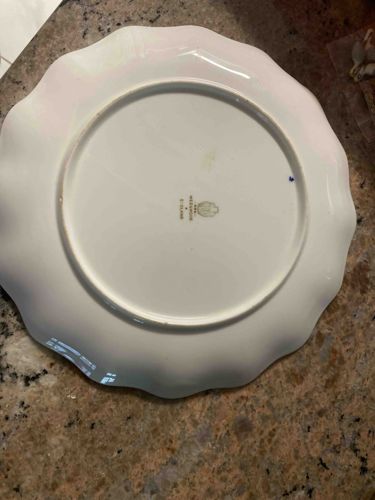
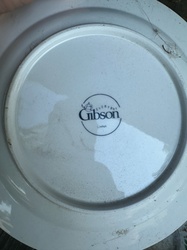
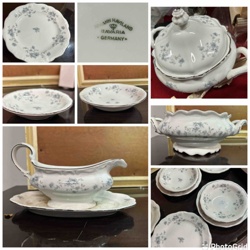
This item is a white ceramic or porcelain plate, presented from its underside. The plate features a distinctive scalloped or fluted edge, adding a decorative and classic aesthetic. The material appears to be high-quality earthenware or fine china, possibly bone china given the subtle translucence suggested by some light reflections. The primary color is a soft, creamy white, with some areas exhibiting a faint iridescent or pearlescent sheen, particularly on the scalloped rim, which could be part of the glaze or an effect of lighting. The back of the plate features a raised foot rim, which helps to elevate the plate slightly and prevent scratching of the surface it rests on. In the center of the underside, there is a visible manufacturer's mark. This mark is predominantly gold or gilded, and appears to feature a stylized urn or vase motif, above text that is partially legible but clearly includes 'WEDGWOOD' and likely 'E. COLAND' (possibly 'B. ENGLAND' or 'B. ENGLAND'). This mark is characteristic of Wedgwood, a renowned British pottery company, and specifically suggests their 'Edme' pattern, which is known for its classical fluted design. There is a small, distinct blue dot or mark near the foot rim, which could be an incidental manufacturing imperfection, a residue, or a decorator’s mark. The overall condition appears good with no obvious chips, cracks, or significant wear visible from this angle, though more detailed inspection would be needed to confirm this. The craftsmanship suggests a mass-produced, high-quality tableware item, likely from the 20th century, given the style and known history of Wedgwood's 'Edme' line.
AI Appraisal Report
I have examined the provided image of this Wedgwood 'Edme' Scalloped Edge Plate. Based on the visual evidence, it is a white ceramic or porcelain plate with a distinctive scalloped rim, consistent with the Wedgwood 'Edme' pattern. The primary color is a soft, creamy white, and the visible manufacturer's mark, though partially obscured, clearly shows 'WEDGWOOD' and likely 'B. ENGLAND' or similar, confirming its authenticity as a Wedgwood piece. The gold or gilded urn motif is also characteristic. The raised foot rim is a standard design feature. A small blue dot noted near the foot rim is most likely a manufacturing indicator or incidental mark, not typically impacting value significantly unless it's a decorator's signature. The overall condition appears good from the underside, with no obvious chips or cracks visible. However, I must note that a full assessment of condition (e.g., surface scratches, crazing, or rim chips) would require a direct, in-person examination of both the front and back surfaces.
Market conditions for individual Wedgwood 'Edme' pieces are generally stable but not exceptionally strong for common items like dinner plates. This pattern was widely produced, making individual pieces relatively accessible. Demand is moderate, driven by collectors looking to complete sets or individuals appreciative of classic tableware. Rarity is low for standard plates within this mass-produced pattern.
Factors significantly impacting value would include pristine condition, any rare variations (which this does not appear to be), or an unusually high number of pieces being sold together as a set. For this single plate, its value is modest.
It is important to acknowledge the limitations of appraising solely from images. While authenticity as a Wedgwood 'Edme' piece can be reasonably established from the mark, a definitive assessment of its exact age, the precise material (e.g., earthenware versus bone china), and most importantly, its exact condition (including any subtle crazing or surface wear on the eating surface) would necessitate a physical inspection. Without handling the item, I cannot confirm the absence of hairline cracks, wear to the glaze, or restoration work that would significantly alter its value.