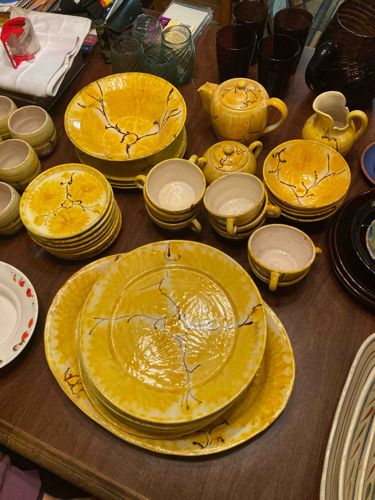
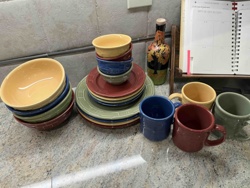
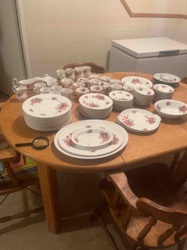
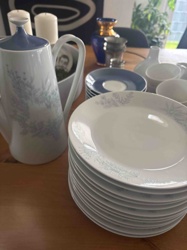
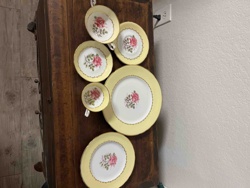
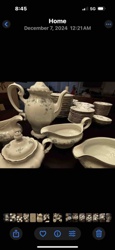
Mexican earthenware dinner set including eight tea cups, a dinner plates, eat, dessert, plates, large serving bowl, or regular bowls, four medium plates, creamer, sugar, and tea pot.
These notes were written by the person who submitted this item. Appraiser.AI has not verified them, and the AI's identification and estimate may rely on them.
AI Estimated Value
Not an official valuation
$250-400
AI estimate as of November 20, 2025 · verify with a professional before acting
AI-Generated · Verify before acting
Everything on this page is generated by AI for informational purposes only. AI can make mistakes — the AI may misidentify items or misattribute them (artist, maker, brand, designer, origin, era). This is not an official valuation and should not be used for insurance, sale, tax, estate, legal, or lending purposes — or any decision requiring a certified appraisal. It is not an authoritative claim about any person, brand, or rights holder — do not share or rely on it as a factual statement about a third party. Always consult qualified professionals before making financial decisions.
This analysis also relies on unverified notes provided by the user, which may be incomplete or inaccurate and could affect the result.
This is a comprehensive Mexican earthenware dinnerware set, predominantly featuring a vibrant yellow glaze with rustic black, branch-like or crackle-patterned accents. The set includes a variety of pieces designed for a full dining experience. Key components visible are dinner plates, smaller plates (likely dessert or salad plates), various bowls including a large serving bowl and smaller individual bowls, eight tea cups, a creamer, a sugar bowl with a lid, and a teapot. The pieces exhibit an irregular, rustic aesthetic characteristic of handcrafted earthenware, with slight variations in color intensity and glaze application across different items. The black patterns are hand-painted, showing individual artistic strokes rather than uniform machine-printed designs. The earthenware construction suggests a sturdy, somewhat heavy feel, typical of traditional Mexican pottery. Visible condition points to general use, with some potential minor scuffs or inconsistencies in the glaze, which are common for this type of pottery and add to its charm rather than detracting significantly from its value. There are no overt chips or cracks immediately discernible from the image. The interiors of some cups appear off-white or very light beige, providing a subtle contrast to the exterior yellow. The overall style points to a mid-20th century to contemporary creation, embodying a folk art or rustic farmhouse aesthetic. The craftsmanship is indicative of skilled artisan work, focusing on robust utility with decorative flair, as evidenced by the consistent, albeit hand-applied, decorative motifs throughout the collection.
AI Appraisal Report
Based on my examination of the provided image and description, this Mexican earthenware dinnerware set presents as a charming and extensive collection. The vibrant yellow glaze with rustic black, branch-like accents is a classic folk art aesthetic. The set's condition appears to be generally good, consistent with use but without immediately discernible chips or cracks. The hand-painted nature of the patterns, and the irregular, rustic aesthetic, are characteristic of handcrafted Mexican pottery and contribute to its authenticity as such. The inclusion of eight tea cups, dinner plates, dessert plates, a large serving bowl, several regular bowls, four medium plates, a creamer, sugar, and teapot makes this a very comprehensive set. This level of completeness enhances its overall appeal and functionality.
Market conditions for vintage or artisanal Mexican earthenware are generally stable, with a loyal niche following. While not typically commanding extremely high prices, a complete and well-preserved set like this does attract collectors and those decorating in a rustic or Southwestern style. The demand is moderate, driven by aesthetic appeal rather than extreme rarity; these pieces were produced in quantities, but finding a full, matching set in good condition is less common. Factors significantly impacting value include the number of pieces, the intact condition of the glazes and pottery body, and the aesthetic consistency across the set.
My appraisal value reflects the perceived good condition and comprehensive nature of this particular set. It's important to note the limitations of image-based appraisal. Without a physical inspection, I cannot confirm the absence of hairline cracks, chips, crazing, or repairs that might be less visible in photographs. Furthermore, verifying the specific artisan or pottery studio, which could influence value, would require in-person examination of any maker's marks or provenance documentation. Scientific testing would be excessive for this type of item and typically not needed for full authentication.