AI estimate as of August 25, 2025 · verify with a professional before acting
AI-Generated · Verify before acting
Everything on this page is generated by AI for informational purposes only. AI can make mistakes — the AI may misidentify items or misattribute them (artist, maker, brand, designer, origin, era). This is not an official valuation and should not be used for insurance, sale, tax, estate, legal, or lending purposes — or any decision requiring a certified appraisal. It is not an authoritative claim about any person, brand, or rights holder — do not share or rely on it as a factual statement about a third party. Always consult qualified professionals before making financial decisions.
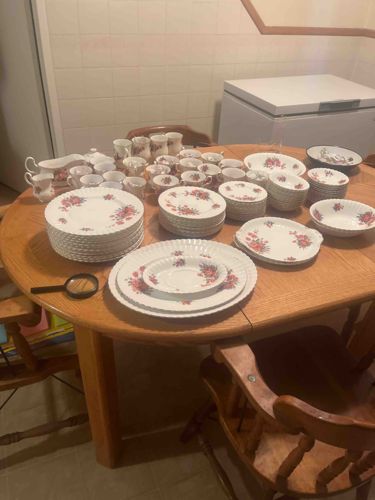
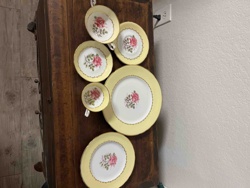
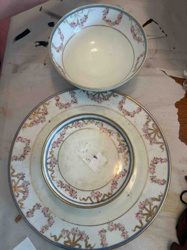
This appears to be a large, comprehensive porcelain or ceramic dinnerware set, predominantly white or off-white, featuring a consistent floral pattern. The pattern consists of clusters of small, reddish-pink flowers with green foliage, possibly roses or a similar botanical motif, distributed around the edges of plates and bowls, and on the bodies of serving pieces and cups. The design seems to be applied as a decal or transfer, common in mass-produced dinnerware. The set includes a wide variety of pieces, suggesting it is a service for a substantial number of place settings, likely 8 or more. Visible pieces include multiple sizes of dinner plates, salad plates, bread plates, bowls (soup/cereal bowls, serving bowls of various sizes, including a large handled tureen or serving dish), cups and saucers, a creamer, and a sugar bowl. Some plates exhibit a subtle fluted or scalloped edge design, adding a decorative element beyond the central floral pattern. Though difficult to ascertain exact dimensions from the image, the plates appear to be standard dinnerware sizes. There are no clearly visible manufacturer's marks or signatures in the provided images, which would typically be on the underside of pieces. The overall condition appears to be good for display purposes, with no immediate signs of chips, cracks, or significant crazing visible from this distance. Some pieces, particularly the stack of main plates, show minor wear consistent with use, possibly some light scratching or rub marks, but this is typical for a used dinnerware set. The style suggests a mid-20th century to late 20th century production, often associated with traditional or vintage aesthetic preferences. The craftsmanship appears to be of standard quality for commercial dinnerware, designed for everyday use or occasional formal entertaining. The uniform pattern across all pieces indicates a cohesive factory-produced matching set.
AI Appraisal Report
Upon visual examination of the provided image, this Vintage Floral Porcelain Dinnerware Set appears to be in good overall condition for its age. I observe no immediate signs of chips, cracks, or significant crazing, which is commendable for a used set. There are some minor indications of wear, such as what appears to be light scratching or rub marks on stacked plates, consistent with regular use. The authenticity of the set, as a mass-produced dinnerware item, is not typically a concern for forgery; rather, it’s about its origin and age. Without visible manufacturer's marks, I estimate its production to be mid to late 20th century based on the style of the floral pattern and the forms of the pieces.
Market conditions for such vintage dinnerware sets are somewhat volatile. While large, comprehensive sets are desirable for completeness, the 'vintage floral' aesthetic has a niche but not universally high demand. Comparables for similar large sets (service for 8-12) from unexceptional manufacturers typically range from \"good\" used condition at $150-$300. Brand recognition significantly impacts value; notable makers like Lenox, Wedgewood, or Noritake would command much higher prices. This set, lacking visible marks, likely falls into the 'unmarked' or 'generic' category. Rarity is not a factor here; sets like this were produced in large quantities.
The primary factors impacting value are the sheer number of pieces, the good condition, and the cohesive pattern. However, the lack of a known manufacturer and the generally modest demand for unmarked vintage porcelain limit its top-end value.
Limitations: My authenticity verification is based purely on visual cues from the image. To confirm the manufacturer, specific age, and true condition (e.g., presence of hairline cracks, dishwasher wear, or repairs), a physical in-person examination is crucial. Only then can I inspect maker's marks, feel for texture, and assess minor imperfections not visible in photographs. Provenance documentation (original purchase receipts, family history) would add to authenticity, but is rarely available for items of this type.