AI estimate as of December 9, 2025 · verify with a professional before acting
AI-Generated · Verify before acting
Everything on this page is generated by AI for informational purposes only. AI can make mistakes — the AI may misidentify items or misattribute them (artist, maker, brand, designer, origin, era). This is not an official valuation and should not be used for insurance, sale, tax, estate, legal, or lending purposes — or any decision requiring a certified appraisal. It is not an authoritative claim about any person, brand, or rights holder — do not share or rely on it as a factual statement about a third party. Always consult qualified professionals before making financial decisions.
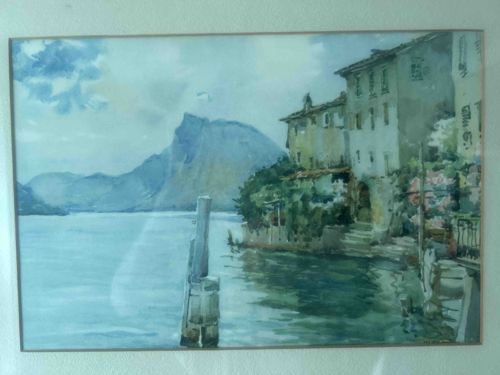
This item is a framed watercolor painting depicting a picturesque European lakeside scene. The composition features a prominent multi-story building with a light-colored facade, likely stucco or plaster, situated directly on the water's edge, surrounded by lush green foliage and hints of pink or red flowering plants. The building exhibits multiple windows and a detailed architectural style, suggesting a Mediterranean or Alpine influence. A set of stone steps leads down from the building to the tranquil waters of the lake. In the foreground, a prominent wooden dock or pilings emerge from the water, showing signs of wear and age, consistent with prolonged exposure to water. The background is dominated by large, imposing mountains, rendered in soft blues and grays, indicating distance and atmospheric perspective. The sky is a light blue with scattered white clouds, suggesting fair weather. The overall palette is soft and predominantly cool tones, with blues, greens, and muted yellows. The painting appears to be under glass and housed in a simple, slim frame, likely made of wood, painted white or a very light neutral color. The visible condition suggests the artwork might be slightly faded or muted with age, and there is a reflective glare on the glass in the photograph, obscuring some details. The brushwork, characteristic of watercolor, shows translucent washes and some delicate detailing, particularly in the architecture and foliage. Based on the style and subject matter, it likely dates from the early to mid-20th century, possibly as a souvenir or landscape study. The craftsmanship appears competent, capturing the serene atmosphere of the scene.
AI Appraisal Report
I have examined the image of this framed watercolor painting depicting a European lakeside village. Based on visual assessment, the condition appears good, though slight fading or muting of colors due to age is possible, and the glare on the glass obscures some finer details. The artwork itself shows competent watercolor technique with translucent washes and decent detailing, indicative of a skilled amateur or perhaps a commercially trained artist. The style, subject matter, and apparent age suggest it is a landscape study or souvenir piece from the early to mid-20th century.
Market conditions for such unframed, unsigned European landscape watercolors by unknown artists are generally modest. Comparable works often sell in the low to mid-hundreds, particularly if they are framed simply, as this one appears to be. Demand for such pieces is steady but not high, primarily appealing to individuals seeking decorative art for their homes. Rarity is low, as many similar scenic watercolors were produced during this period. Factors impacting value negatively include the likely lack of a signature, which prevents attribution to a known artist, and the absence of any unique historical or artistic significance. The simple framing adds some presentation value but is not a significant driver of price.
It is crucial to note the limitations of authenticity verification from images alone. Without physical inspection, I cannot confirm the medium definitively (though it strongly presents as watercolor), nor can I inspect the reverse for signatures, inscriptions, or gallery labels that would provide provenance. An in-person examination would allow for a detailed assessment of the paper, pigment condition, and precise framing quality. Provenance documentation, such as receipts or exhibition history, would be needed for full authentication to a specific artist if a signature were present. Scientific testing, like pigment analysis, would only be considered for works attributed to significant artists.