AI estimate as of November 10, 2025 · verify with a professional before acting
AI-Generated · Verify before acting
Everything on this page is generated by AI for informational purposes only. AI can make mistakes — the AI may misidentify items or misattribute them (artist, maker, brand, designer, origin, era). This is not an official valuation and should not be used for insurance, sale, tax, estate, legal, or lending purposes — or any decision requiring a certified appraisal. It is not an authoritative claim about any person, brand, or rights holder — do not share or rely on it as a factual statement about a third party. Always consult qualified professionals before making financial decisions.
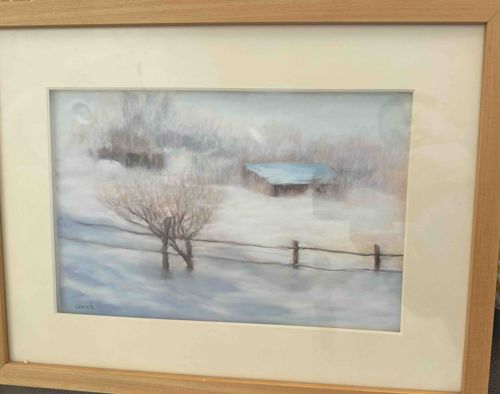
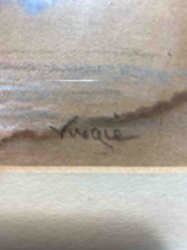
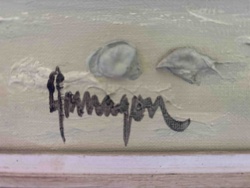
This is a framed artwork, likely a painting or print, depicting a tranquil winter rural landscape. The primary colors are muted blues, whites, and browns, indicative of a snowy scene. In the foreground, a bare, gnarled tree stump with multiple branches emerges from the snow, framed by a rustic fence composed of horizontal lines connecting three visible vertical posts. The fence appears to be made of dark wood or branches. In the middle ground, a small, simple structure with a blue-tinged roof, possibly a shed or barn, is partially obscured by snow and what appear to be faint, bare trees or brush. The background is indistinct, suggesting a hazy or falling snow effect, with shades of light blue and white blending into the sky. The overall impression is one of peaceful desolation. The artwork is housed under glass within a light-colored wooden frame, possibly oak or a similar light-grained wood, with a visible grain pattern. The frame has a simple, clean profile. A cream or off-white mat board surrounds the artwork, providing a border between the image and the frame. The visible condition appears good, with no obvious damage to the frame, mat, or the artwork itself, although a light reflection is visible on the glass in the upper left quadrant. A faint, dark signature or inscription is present in the lower left corner of the artwork, which is difficult to decipher but appears to read "GLOVER" or similar. The style suggests a contemporary or modern approach to landscape painting, possibly late 20th or early 21st century, focusing on atmosphere and mood rather than sharp detail. The quality indicators suggest a professionally framed piece, indicating a certain level of care and presentation.
AI Appraisal Report
Based on my visual examination of the provided image, I assess this framed artwork, a Winter Rural Landscape, to be in good overall condition. The frame and mat appear well-preserved, and there are no obvious visible damages to the artwork itself, though a reflection on the glass makes a full assessment difficult. The signature, which I tentatively decipher as "GLOVER," is a key element for authenticity. However, verifying its authenticity from an image alone is impossible.
Without physical inspection, I cannot confirm the medium (oil, acrylic, print, etc.) which significantly impacts value. The style suggests a contemporary piece, likely late 20th or early 21st century. The muted color palette and atmospheric quality are appealing but common. While the framing indicates professional presentation, the overall artistic merit, from the limited view, appears modest.
Market conditions for unsigned or lesser-known landscape artists of this vintage are generally moderate. Comparables would include other framed, contemporary landscapes of similar size and artistic quality, typically found in online sales or local galleries. Demand is steady but not high for such pieces, and rarity is unlikely given the stylistic universality. Factors impacting value are primarily the artist's identity and reputation, which are unknown here, and confirmation of it being an original painting rather than a print.
For a full authentication and more precise valuation, an in-person examination is crucial. This would allow me to verify the medium, inspect for any hidden damages, and properly analyze the signature's characteristics. Provenance documentation, such as purchase receipts or artist's statements, and potentially scientific testing of the materials would be essential to confirm authenticity and artist attribution, especially for a definitive "GLOVER" attribution.