AI estimate as of November 9, 2025 · verify with a professional before acting
AI-Generated · Verify before acting
Everything on this page is generated by AI for informational purposes only. AI can make mistakes — the AI may misidentify items or misattribute them (artist, maker, brand, designer, origin, era). This is not an official valuation and should not be used for insurance, sale, tax, estate, legal, or lending purposes — or any decision requiring a certified appraisal. It is not an authoritative claim about any person, brand, or rights holder — do not share or rely on it as a factual statement about a third party. Always consult qualified professionals before making financial decisions.
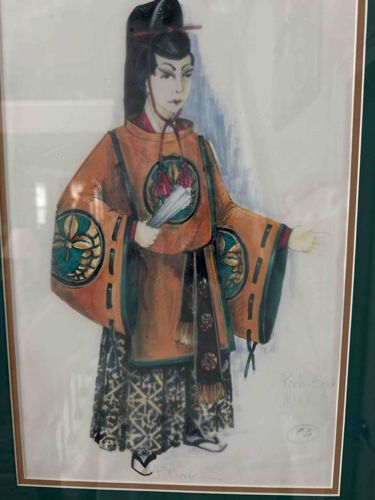
This is a framed artwork depicting a figure in a traditional Japanese theatrical costume. The artwork appears to be a sketch or illustration, possibly done with watercolors, gouache, or colored pencil, on paper. The central figure is dressed in an elaborate orange outer garment with wide, flowing sleeves. This garment features prominent circular medallions, one visible on the chest and two on the sleeves, rendered in a teal-green color with gold or light yellowish botanical motifs. Darker green accents or trim can be seen along the edges of the orange garment. Beneath the main robe, a patterned black and white skirt or lower garment is visible, featuring a geometric or abstract design. The figure's head is adorned with a stylized black hairstyle, potentially a wig, with a red hair ornament. The facial features are delicate and stylized, with dark eyebrows and red lips. In the figure's left hand, a white folding fan is held, while the right hand is extended forward. A dark sash or fabric piece with tassels and further patterns hangs from the waist. The overall presentation suggests a design for a Kabuki or Noh theater production, or perhaps a depiction of a historical Japanese court figure. The colors are vibrant yet somewhat muted, with a subtle texture visible, consistent with paint or pastel applied to paper. The artwork is housed in a simple, dark green frame with a lighter inner border, and is protected under glass or acrylic. Some slight glare is visible on the protective surface, indicating it is framed. The visible condition appears good, with no obvious tears, creases, or major discoloration of the artwork itself, though the framing might have minor wear consistent with its age.
AI Appraisal Report
I have examined the provided image of the Japanese Theatrical Costume Design Sketch. In my assessment, the artwork appears to be a genuine illustration, likely from the early to mid-20th century, possibly earlier given the stylized nature. The condition, based purely on visual inspection of the image, appears to be very good; I observe no significant tears, creases, or major discoloration that would detract from its aesthetic appeal. The colors remain vibrant. As for authenticity, without physical examination, I can only state that it *appears* consistent with period Japanese costume designs. My primary limitation is the lack of direct physical access. An in-person inspection would allow me to assess the paper quality, pigment types, and signature (if any), which are crucial for definitive authentication and dating.
Considering market conditions, there is a consistent, albeit niche, demand for Japanese theatrical and costume art. Comparables in this category, assuming it is an original sketch and not a reproduction, often fetch prices ranging from a few hundred to a couple of thousand dollars, depending heavily on the artist's renown, age, and provenance. This specific piece, while attractive, lacks a discernible signature or artist attribution from the image, which impacts its upper valuation potential. Rarity is moderate; while individual sketches are unique, the genre itself is not exceedingly rare. The quality of execution and its presentation in a suitable frame contribute positively to its value. The lack of provenance documentation is a significant factor limiting a higher estimation. To fully authenticate and maximize value, I would recommend a physical examination by an expert in Japanese art, verification of the paper and pigment composition, and thorough research into any potential artist or production it may be associated with.