AI estimate as of November 6, 2025 · verify with a professional before acting
AI-Generated · Verify before acting
Everything on this page is generated by AI for informational purposes only. AI can make mistakes — the AI may misidentify items or misattribute them (artist, maker, brand, designer, origin, era). This is not an official valuation and should not be used for insurance, sale, tax, estate, legal, or lending purposes — or any decision requiring a certified appraisal. It is not an authoritative claim about any person, brand, or rights holder — do not share or rely on it as a factual statement about a third party. Always consult qualified professionals before making financial decisions.
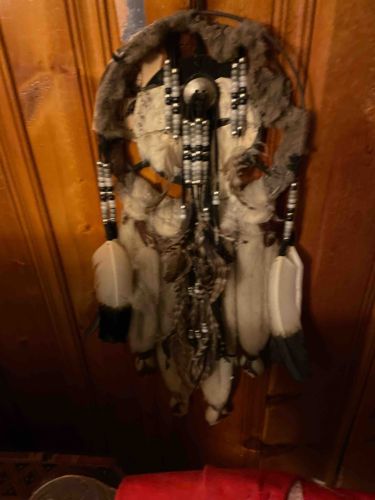
This item is a tribal-inspired decorative wall hanging or possibly a dreamcatcher, characterized by a circular primary structure adorned with various natural and man-made elements. The main hoop appears to be made from a firm, possibly metal or wooden, frame that is wrapped with what looks like distressed or aged animal hide or faux fur in shades of gray and brown, giving it a rustic and organic aesthetic. The central part of the design features several strands of beadwork, predominantly in black and white or off-white opaque beads, strung together to create multiple dangling elements. There are at least four prominent beaded strands hanging from the top section, with a central, larger, circular or oval metallic (possibly silver-toned) disc or medallion that acts as a focal point. Directly beneath this, more strands of beads and what appear to be natural feathers are suspended. The feathers are varied in size and color, predominantly white with dark tips, suggesting natural bird feathers. Some sections show signs of wear, such as fraying on the wrapped material around the hoop and possible discoloration on the feathers. The craftsmanship appears to be folk art or handcrafted, aiming for an aged, natural, and earthy look. There are no visible maker's marks or signatures. The overall style suggests a Native American or indigenous craft influence, likely a contemporary decorative piece rather than an ancient artifact, possibly dating from the late 20th or early 21st century. The quality is consistent with handmade decorative items, exhibiting character over precise uniformity.
AI Appraisal Report
Based on my visual examination of the provided image, this Tribal-Inspired Decorative Wall Hanging presents as a contemporary, handcrafted item, likely produced in the late 20th or early 21st century. The condition appears consistent with a decorative piece that has seen some display; I note some fraying on the wrapped material around the main hoop and potential discoloration on the natural feathers, which is normal for such materials over time. Authenticity, in terms of being a genuine artifact from an indigenous culture, is highly unlikely. The style, while influenced by Native American aesthetics, strongly suggests it is a decorative interpretation rather than an authentic tribal piece, especially given the lack of specific tribal identifiers or traditional craftsmanship markers. Without provenance or maker's marks, it's categorized as 'tribal-inspired' folk art.
Market conditions for such decorative items are generally modest. Comparables are found in craft fairs, online marketplaces (e.g., Etsy, eBay for handmade goods), and home decor stores, rather than fine art or antique galleries. Demand is limited to those seeking rustic or boho-chic home decor. It is not rare; similar items, often mass-produced or by hobbyist crafters, are readily available. Factors impacting value negatively include the lack of documented provenance, the non-authentic nature as a tribal artifact, and the general availability of similar items. Its value is primarily decorative.
Limitations in authenticity verification from images alone are significant. While I can assess the visual style and apparent materials, an in-person examination would be crucial to determine the actual materials used (e.g., real animal hide versus faux, specific types of feathers, metal composition of the disc). Provenance documentation would be essential to ascertain any genuine connection to an indigenous artisan or culture, which is currently unsupportable. Scientific testing of materials would further confirm composition, though this is usually impractical for items in this value range. Without these, it remains a charming, handcrafted decorative item.