AI estimate as of November 17, 2025 · verify with a professional before acting
AI-Generated · Verify before acting
Everything on this page is generated by AI for informational purposes only. AI can make mistakes — the AI may misidentify items or misattribute them (artist, maker, brand, designer, origin, era). This is not an official valuation and should not be used for insurance, sale, tax, estate, legal, or lending purposes — or any decision requiring a certified appraisal. It is not an authoritative claim about any person, brand, or rights holder — do not share or rely on it as a factual statement about a third party. Always consult qualified professionals before making financial decisions.
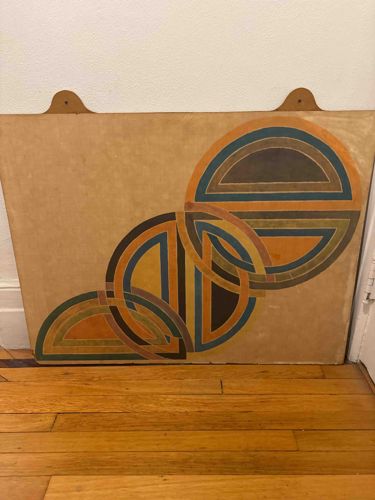
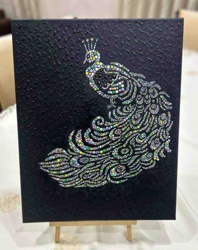
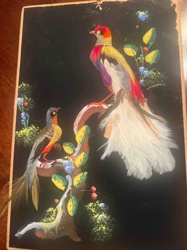
This item is a large, rectangular wall hanging featuring a geometric abstract design. The primary material appears to be a soft, tanned material, likely suede or a heavy felt, with a light brown or tan base color, which exhibits some variations in tone, possibly due to aging, dirt accumulation, or inherent material qualities. The artwork consists of overlapping and interlocking semi-circular and curved banded forms, rendered in a palette of earthy and muted tones including deep teal, various shades of orange (from bright to muted), dark brown, and possibly olive green. These bands create a sense of depth and movement within the composition. The construction suggests an appliqué or a painted design technique applied directly onto the textile surface. Two wooden or possibly leather tabs are visible at the top edge, suggesting that the item is designed to be hung from a rod or hooks; one tab appears to have a single circular perforation, likely for a hanging mechanism. The overall condition shows signs of age and wear; the base material has a somewhat faded and slightly uneven appearance, consistent with a vintage item. There are no obvious tears or significant damage, but the edges appear soft and possibly worn. The colors of the geometric patterns seem relatively well-preserved, though they might be slightly muted from their original vibrancy. The style points towards a mid-20th century aesthetic, possibly in the vein of a more accessible, decorative art piece inspired by Op Art or other geometric abstraction movements. The craftsmanship appears to be of decent quality, exhibiting clean lines in the geometric shapes, though without closer inspection, it's hard to discern fine details of the application technique. The item’s size suggests it is intended as a significant decorative element.
AI Appraisal Report
This geometric abstract wall hanging, appearing to be crafted from suede or heavy felt, presents an earthy and muted color palette of teal, orange, brown, and possibly olive green in its overlapping semi-circular forms. Its style points to a mid-20th-century aesthetic, likely influenced by geometric abstraction or Op Art, and intended as a significant decorative piece. The construction suggests appliqué or a painted design. Condition-wise, the piece shows signs of age and wear consistent with vintage textile art. The base material has a faded, uneven appearance, and the edges seem soft. However, there are no obvious tears, and the geometric pattern colors remain relatively well-preserved, though possibly muted. The presence of two hanging tabs, one with a perforation, confirms its intended display method. Based on current market conditions for decorative vintage abstract textile art, similar pieces, especially those without a known artist or significant provenance, typically fall into this range. Demand is steady for unique, well-preserved decorative items from this era, but rarity is not exceptionally high for unsigned pieces. Factors impacting value positively are its substantial size and appealing design; negatively, the signs of age and lack of artist attribution. Limitations in authenticity verification from an image alone are significant. A physical examination would be crucial to determine the exact material (suede vs. felt) and the precise application technique (painted vs. appliqué), as well as to thoroughly inspect for subtle damages, fading, or repairs not visible in an image. Provenance documentation could significantly enhance value by confirming origin, artist, or designer, which is currently unknown. Without these, its value remains primarily decorative.